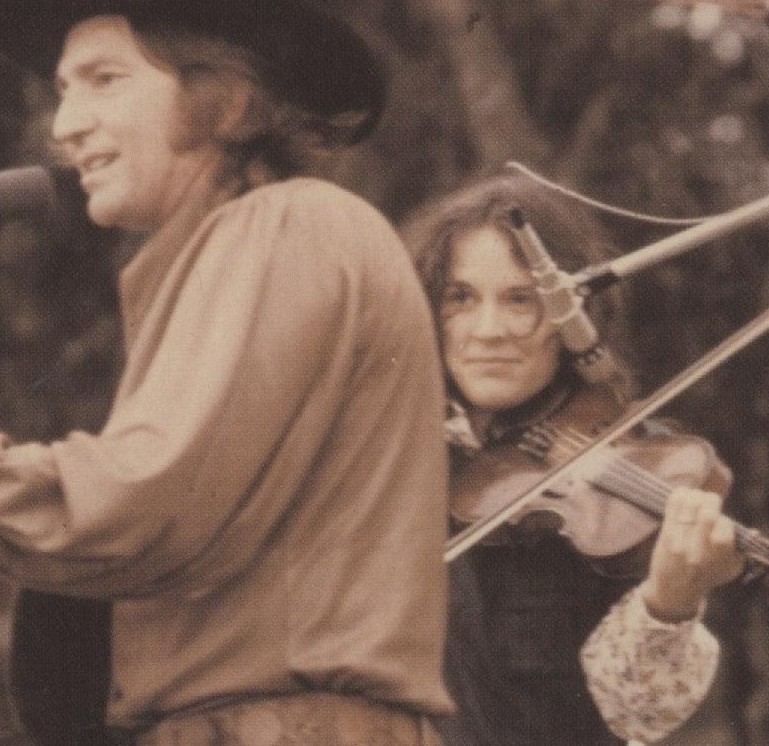
Featured image of Sweet Mary playing with Willie Nelson at the George McGovern rally in Austin’s Zilker Park, 1972. Photo by Bellmer Wright.
Mary Egan was just passing through.
She and her husband Robert (known to everyone – including Mary – as “Egan”) had no plans to stay in Austin – why would they? It was 1970, they had just given the rednecks the slip in Santa Fe, and now they’re in Texas of all places? Forget it.
Egan knew exactly one soul in Austin – his friend Pete whom he’d gone to school with in Michigan. Pete and his wife Betsy offered the couple a place to crash for the night on their way east to somewhere else.
Pete was (and I’m not kidding) the inspiration for one of Gilbert Shelton’s Fabulous Furry Freak Brothers, and his wife Betsy sang regularly in Kenneth Threadgill’s legendary open jam sessions which were held in what author Jan Reid called “the shrine of Austin music”: Threadgill’s tavern in an old filling station on the north side of town. In the 60s, the Threadgill’s crowd had included such future luminaries as Janis Joplin and Bill Malone, author of Country Music, USA.
Everyone was welcome at these sessions, and Betsy invited Mary to come along and bring her fiddle, so she did. She had a great time and decided she just might do it again the next week… and then again the week after that… and maybe… maybe Austin wasn’t so bad.
Meanwhile, New York transplant Cleve Hattersley had just formed a groovin’ little hippie combo called Greezy Wheels, and he happened to stumble upon Mary sitting in with Threadgill one night. He saw his future and asked her to join the band on the spot. She accepted.
According to journalist Michael Corcoran:
“By … ‘73, Cleve’s Greezy Wheels were the biggest Austin band, taking in as much as $2000 a night when they packed the Armadillo [World Headquarters]. … Major labels were circling. … The rootsedelic playing of ‘Sweet Mary’ … reshaped country standards, causing fans to do a dance James White of the Broken Spoke called ‘the Hippie Hop.’ Greezy Wheel’s first big gig was opening for the Flying Burrito Brothers at the Dillo in June 1971, [and] the word spread about a sensational hippie chick fiddler in Austin.”
Mary – christened “Sweet Mary” by Lissa Hattersley (Cleve’s sister and fellow Greezy Wheel) and so well known by that sobriquet that when I asked “How did you get your nickname?” she replied “What nickname?” – also found herself in Jerry Jeff Walker’s circle, playing on his 1972 self-titled debut for MCA and its follow-up, ¡Viva Terlingua!
Corcoran quotes Lost Gonzo Gary P. Nunn telling the Austin American-Statesman: “I give [Mary] credit for getting the ball rolling in this town. She’d play that ‘Orange Blossom Special’ at the Hungry Horse on San Jacinto and the hippies would get off so bad.”
Near the end of the 70s, the Wheels took an extended break, and Mary and Cleve (who had gotten hitched in ‘74) headed to New York City to manage the world-famous Lone Star Cafe. After spending half the 80s in New York making the scene and playing around with their friend, musician/humorist/author/eventual-Texas-gubernatorial-candidate Kinky Friedman, they returned to Texas and, in 2022, moved all the way out to Mary’s hometown of Las Cruces, New Mexico.
Now she’s back where she started, and at the same time there’s another loop being closed for the Greezy Wheels: Armadillo Records, established in Austin in 1969, just released what will be the Wheels’ final album. According to the label’s website, “No band played more at the [Armadillo World Headquarters] than Greezy Wheels. … We Come We Go brings them full circle: back to the label that shares … their legacy.”
Says Sweet Mary: “I mean, we were just passing through, you know?”
—
Sweet Mary Hattersley (credited as Mary Eagan [sic] on ¡Viva Terlingua!): It was Gary P. Nunn, I think, who recommended me to Jerry Jeff, because he was helping him put together this album – the first one we did – Jerry Jeff Walker. That’s when I was first in the project. So when they decided to do [¡Viva Terlingua!] in Luckenbach, they invited me to do that because we had this thing going on, you know?
I’m sure that Gary P. saw me at the Armadillo, because [Greezy Wheels] played there all the time. We were kind of like the house band; we opened for everybody. We opened for Bruce Springsteen when he was brand new and nobody knew who he was, and we opened for Willie [Nelson] when he was just crossing over from being a Nashville cat to being the spearhead of this different kind of country music, right? Country music and hippies were kind of at odds until the Armadillo and Greezy Wheels started mixing it all up.

When was the first Greezy Wheels gig at the Armadillo?
SMH: ‘71. And we were a big hit! Not with “Orange Blossom” yet; we were just hippies. Our big hit was “Get My Mind Together.”
Oh, I love that one!
SMH: Yeah, I do, too. [Cleve] started the band; he started as a solo act. Then he found these two hippies, [and] they just gelled; they made this sound. It was Pat [Pankratz] and Mike [Pugh], who [were] Deadheads, but they were Texans and they had a feel for Texas country music. Pat had a beautiful voice, and he played guitar like Jerry Garcia.
Anyway, they were a trio, and they decided they needed a color instrument of some sort and they saw me playing with Kenneth Threadgill. And we just made this immediate connection. I think they invited me in because I didn’t know anything about [country music]. The way I played the fiddle was just stuff I made up; it was the hippie version! And so I [became] part of the scene.
All those musicians were more experienced than me. I grew up as a classical violinist, and I had never even thought about being in a band. But when I moved to Austin and started sitting in with Threadgill, I heard – like the first night I was there – this guy playing an electric violin at the Armadillo. It was Spencer Perskin [from Austin psychedelic band Shiva’s Headband], and it had never occurred to me to play an electric violin! And Egan, he was excited about my being in a band, so he went right out and bought me a pickup. So I was playing electric violin with my new pickup at Threadgill’s. The old musicians… you know, Mr. Threadgill was already what I thought was old at that time – he was in his 50s, right?
[laughter]
SMH: So, he was this great yodeler, and he taught me all these Jimmie Rodgers songs. Believe me, I knew nothing about… I eschewed country music. I had no connection to country music up until that moment. But when I moved to Austin, all these musicians just embraced me, you know? They said, “Oh, you play fiddle well. Play ‘Orange Blossom Special.’” I didn’t even know what it was!
Greezy Wheels … were not a country band – they were a bunch of Deadheads, and Cleve was from New York. But that was right up my alley because one thing I had done was a lot of drugs. I had gone to San Francisco and taken acid – a lot – and I had to leave San Francisco because my husband at the time [Lenny] got busted and we needed to get out of there.
What years were you in San Francisco?
SMH: 1963, ‘64, ‘65.
That’s early! Before the Summer of Love?
SMH: It was very early; I’m a very early hippie, I’m telling you. I have been a hippie for a long time. Anyway, we got in trouble, so we moved back to New Mexico, which is where we were from, Lenny and me. We decided to move to Santa Fe; a lot of people had moved to Santa Fe because in New Mexico you could take acid, [and] they had legalized peyote.
[Later,] Egan and I escaped from Santa Fe to Austin, and I say “escape” because it was kind of a precarious existence being a hippie, you know.
Was Santa Fe very conservative?
SMH: No; it was an artist colony. There were a lot of artists in Santa Fe, and I hung out with all the artists and poets and the people who were taking peyote.
So why was it precarious?
SMH: It was precarious because rednecks didn’t appreciate us; straight people didn’t appreciate us. It was a scary time. Believe me, if you were a boy and you had long hair in those years, it was precarious. It was not welcome. I mean, it was welcome in the art community, in the music community, in the poet community – but not in the regular community.
And Texas was just mind boggling, because we were terrified of Texas; Texas was where hippies got shot – but in Austin there were all these hippies! Austin was a huge melting pot, because it was the state capital and the home of a huge university – and so people came to Austin from everywhere, from all over the state. Artists and musicians and poets and philosophers, you know? And so it turned out to be a haven where we could exist; so we stayed there.
And this was 1970?
SMH: Yeah. In 1970, everybody moved or did something. Ran away. The boys were still trying to stay out of Vietnam. Everybody I knew was in the peace marches. And the boys in the band on ¡Viva Terlingua!, they were a bunch of hippies, too; they weren’t just regular country musicians. They were revolutionaries, you know?
Yeah, they all started in rock and roll.
SMH: But they were Texans!
So they grew up with country music.
SMH: So they grew up with it; I did not.
There’s not a lot of country music in Las Cruces?
SMH: I’m sure there is. When I was in Las Cruces – which was when I was a little girl – I was in the orchestra; I played in the El Paso Symphony. So I played violin all my life, but I didn’t really take up fiddle until I moved to Austin.
You know, Cleve was my main musical influence, because when he put together the Greezy Wheels they just let me be – let me develop my style.
According to Cleve in his 2019 memoir Life Is a Butt Dial, he had assembled Greezy Wheels in the wake of a pot-smuggling bust in which he “was the careless criminal, the one who inevitably gets caught, the one who should never have chosen that line of work in the first place. … The two-and-a-half years of appeals kept [him] out on bail and gave [him] a few extra universal minutes to figure out what piece of the puzzle came next.” That piece was Greezy Wheels, and he finally had “something [he’d] never had before: purpose and focus.”
Cleve was in [the penitentiary at] Huntsville for most of ‘73, right?
SMH: He was. By that time we were gelled [as a band], and Cleve’s sister had come down to sing with us – Lissa. And so Lissa held the band together; we all just stuck together and kept a-going. We were playing all the time – like at Soap Creek Saloon on Wednesdays and Armadillo all the time.
1973 was an incredible year for me and for the Austin scene, you know?

In the liner notes for ¡Viva Terlingua!, Jerry Jeff thanks you for “driving between gigs,” so I assume that you were just constantly going back and forth from Luckenbach to Austin.
SMH: I was driving back and forth every day.
Did you stay in Fredericksburg at all during that time, with the rest of the band?
SMH: No. Well, we would be in Luckenbach all day every day; so we hung out all day together, but I didn’t sleep there. Egan and I would drive home.
From listening to the record, it sounds like you were there the whole week and played on everything except for the show. Were you not there for the show on Saturday? I don’t hear your fiddle on those recordings, so I’ve assumed that maybe Saturday night you were in Austin playing with the Greezy Wheels.
SMH: I think I was. Yes, I was.
There was another song recorded on Sunday, “Wheel,” and you’re on that. So you must have gone home Saturday night and come back Sunday to record one last song.
SMH: I remember that “Wheel” song; it’s beautiful.
The story I’ve heard is that all the Gonzos showed up that morning on acid thinking the sessions were over and were completely caught off guard about having to do another song.
SMH: I think it was acid. And I had taken so much acid that I just got a contact high from them. It was a very stoned recording, really.
It seems like it would be hard to do a good recording if you’re that stoned, but it obviously worked.
SMH: Well, no. If you’re stoned on acid but you’re with people that you’re comfortable with, it’s really fun to play music on it, because you’re all very connected. You’re in the same connected headspot; you’re more connected than normal. It goes very well. I mean, the Dead were on acid quite a bit when they played; I played on acid a lot. It’s fun to play on acid… if you’re used to it, you know? [If] you’re comfortable in that space.
It must have been a comfortable environment out there at Luckenbach.
SMH: Oh, we all loved each other. It was really a very nice feeling working with those musicians and being in Luckenbach. We were very close.
There weren’t a lot of women involved in the recording; did you know [singer] Joanne Vent very well?
SMH: No. The boys in the band were, I guess, the ones that I knew the most. Michael McGeary – we called him Miguel. I love Michael. His experiences were so very wide, you know? His musical experiences. But all of the guys, they all had contributed a wide variety of influences.
Talk about a wide variety of influences: On “Sangria Wine,” are you playing your fiddle pizzicato on that?
SMH: Yeah, yeah.
It’s an unusual sound on a country record.
SMH: Yeah, I know, but it seemed like the right thing to do.
Completely. Did you have anything to do with the idea to interpolate “Is Anybody Goin’ to San Antone” into that? You and [Lost Gonzo steel guitarist] Herb Steiner are the ones who kick off with it right in the middle of the song.
SMH: Oh yeah, well, Herbie just told me what to do, and I did it.
[laughter]
SMH: He was great, too; he was really sweet. [And producer] Michael Brovsky – I would play through a whole song, and he would take out just the right parts. He would go through and edit it.
What, like flubs?
SMH: No, not flubs. I would play all the time, but I didn’t really know how to weave in and out like I do now. He would make me weave in and out.
He would drop your volume?
SMH: He would drop me out if I was playing over someone else’s thing so that I sounded like I knew what I was doing. I wanted to give Michael Brovsky credit for that. He would catch my brilliance and then cut out my stupid.
[laughter]
SMH: [Lost Gonzo keyboardist] Kelly Dunn would help me, too. He told me, “When you do a spooky thing, you use the diminished arpeggio.” And I knew what the diminished arpeggio was from classical, but I didn’t know that trick. I didn’t realize that if you use that arpeggio when you wanted to be spooky that it would automatically be spooky!
That’s interesting! Is that what you did on “Wheel”?
SMH: Yeah, that’s when he told me that.
That’s fascinating.
SMH: Isn’t it neat? They were a bunch of great musicians, and I was this hippie just playing what I heard, you know? Kind of organically. And so they helped me. We were all just having a ball. All the songs were fun, and we’d just get out a song, and we’d play it, and I would stand over by Gary P. so that I could see what was going on.
So after you’d already played on two albums with Jerry Jeff Walker, was Greezy Wheels at all concerned that he was going to try to steal you away?
SMH: Well, there was no chance of that; I wasn’t going to leave the Greezy Wheels. Greezy Wheels was my heart.
You never played with him again, did you?
SMH: No, I didn’t. Because right after that, when Cleve got out of prison, [Greezy Wheels] got a recording contract, and we started touring. I was out of the picture after that. I was just waiting for him to get out of prison.
Cleve told Michael Corcoran that “everybody tried to steal Mary” and that “Walker often showed up at Wheels gigs drunk, loudly heckling [him].”
Is there anything else from that week that stands out to you?
SMH: [Luckenbach co-owner] Guich Koock stands out in my mind; he kind of hosted the whole event. He was there telling us stories about Luckenbach, and he gave the whole thing a special, rootsy feeling.
And that was Guich? Not [co-owner] Hondo [Crouch]?
SMH: Yeah. Well, it’s Guich who I heard. Hondo was there, too, I’m sure.
Interesting. You’re just the first person who’s mentioned Guich to me.
SMH: Isn’t that weird? He was such a big part of it to me! It’s funny – I just remember him telling us all these stories about Hondo and Luckenbach, and for me Texas history was all new – I didn’t know it. So it was fascinating, and just being in that old building where they took that [album gatefold] picture. We hung out there a lot on breaks. I remember Egan and Jerry Jeff drinking into the night. We stayed real late and got drunk with everybody; we didn’t miss out on much by not sleeping there.
There’s a picture of you in the album photo collage helping a little kid with a fiddle. Do you remember who the kid was?
SMH: No. I mean, I remember it, because he just asked me about it, and so I showed him how to play it, and somebody took a picture of it. But it was before I was teaching – I ended up teaching children how to play the fiddle. I had a whole career doing that, because I fell in love with the Suzuki method and taught children how to play.

So Greezy Wheels made two albums for London Records, and then I think you split up for a while in ‘78, right? And that’s when you and Cleve moved to New York and worked at the Lone Star Cafe?
SMH: Right. The band didn’t really like touring that much; it’s fun, but it’s tough. Half of us were vegetarians, and it was really hard to do on the road.
I still saw [the Gonzos] all the time; they would come up because of the Lone Star. Everybody played at the Lone Star Cafe. And they all came back and played for me when I got cancer in 2000; we had this giant benefit [at Austin club La Zona Rosa]. They came and played, and Jerry Jeff played, and Shawn Colvin played, Asleep at the Wheel played. Because these bands were part of my life. It was a really wonderful concert.
And you beat the cancer!
SMH: Yeah! Here I am, an octogenarian about to go on tour again. Life is funny. We put the band back together in 2000, because at that benefit Freddy [Fletcher] offered us some time at Arlyn Studios, and we decided to form the band again. So the band now is me and Cleve and Lissa – his sister – but we have this whole new rhythm section we kind of stole from Edie Brickell and the New Bohemians, which was a Dallas hippie band. I mean, our hippie roots, we never left.
I’m a big fan of Edie and the New Bohemians.
SMH: That was a wonderful band.

So you made this new record for Armadillo Records, right?
SMH: Yes, they wanted to make a vinyl, and we’d been recording since 2000, but we’d just been making CDs ourselves. We did a lot of recording in John Bush’s garage in Austin. John is the percussionist with Edie Brickell and the New Bohemians, and he’s our drummer. So he’s the drummer on We Come We Go, except it has some old recordings on it, too. It has a live cut of “99 and a Half Won’t Do,” [from when] our drummer was [Lisa Pankratz]. There’s so many great musicians on that album.
Hank Alrich [ran] Armadillo Records in [the early years]. He’s very instrumental in a lot of things with the Armadillo, [and] he introduced me to the man who made my violin. He took me to San Antonio to meet this guy, a violin maker from Czechoslovakia that he’d heard about – Vlademerius Tkac. Hank introduced me to him, and I bought my violin – which I’m still playing.
When was that?
SMH: Would’ve been ‘73. It’s been through a lot, but people have put it back together. I drove over it one time!
How did you manage to do that?
SMH: Well, I had cataracts, and I put it on the ground to load it in, and it was still on the ground and I backed over it. Oh, it was horrible. But this guy in Austin looked at it and said, “I like puzzles,” and he put it back together.
That’s amazing.
SMH: Wait’ll you see it. It is amazing. Anyway, it still plays music, so what can you do?
[The author would like to thank Emily Gianopoulos at Armadillo Records.]
-30-



Leave a Reply