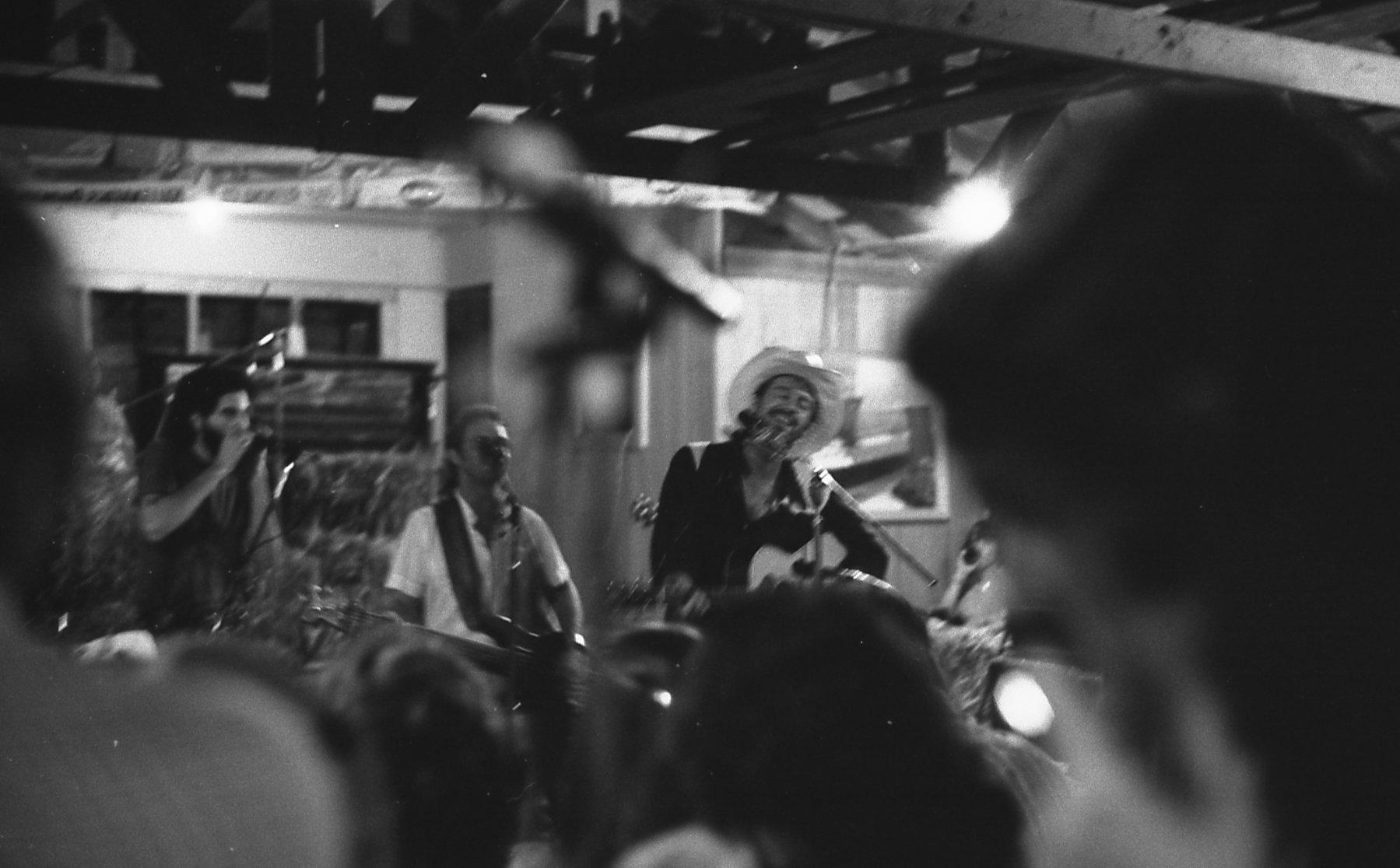
Featured photo of Mickey Raphael, Gary P. Nunn, and Jerry Jeff Walker onstage in Luckenbach, August 18, 1973. Photo by Jim Allison; courtesy of Malinda Allison.
In 2017, Jim Allison was in his office at UT MD Anderson in Houston when he received a message from a nurse’s aide elsewhere in the hospital that a cancer patient – a John Walker, or maybe it was a Jerry Walker? – would like to meet with him.
Allison’s first thought was: “Why would a patient want to meet with me? I’m a scientist, not a physician.”
As a scientist, Dr. Allison would be awarded the Nobel Prize in Physiology or Medicine in 2018 for his work on blocking T-cell inhibitory pathways, ultimately leading to the clinical development of ipilimumab, a drug that has so far allowed more than 300,000 people to stop their cancer therapy and remain cancer free at least five years out. One of the most awarded and honored scientists of the last couple of decades, he is the subject of the 2019 documentary film Jim Allison: Breakthrough.

He also just so happened to be part of a rather fortunate audience one hot summer night in 1973 when Jerry Jeff Walker and the Lost Gonzo Band recorded ¡Viva Terlingua!’s climactic live performance in Luckenbach, Texas.
Back in 2017 it dawned on him.
He messaged the aide and asked, “Who wants to meet with me?” The reply came: “The name on the form says ‘J. J. Walker.’”
“OK, yeah. I’ll be there.”
—
Dr. James Allison: I went down. We talked for a long time, and I told [Jerry Jeff] that I’d been there [at Luckenbach] and all this, and I stayed there about an hour. The nurses had to finally chase me off, you know, and they told me he was leaving. I stayed in touch with him after that, [and] we developed a relationship that way. [Jerry Jeff’s wife Susan] wrote me after he had passed and said that he had told her that I was in there and how ironic it was, because he had received the drug that I had developed.
He took ipilimumab?
JA: Yeah, and I didn’t know that, but that’s what I was told. So he thought, “Here’s this guy that saw me back at Luckenbach when he was a student, and now he’s made this drug that I’m getting.” He told her about it, and she wrote me and said, “Would you come and tell that story [at the ¡Viva Terlingua! 50th anniversary concert]?” And that night [at the concert], I just… I don’t know. I started to tell it there, but I just choked up for one thing, and then I just thought, “If I don’t tell it exactly the right way, it ends up being about me and not him.” And I didn’t want it to be about me, and so I didn’t know exactly what to do. She really wanted me to tell it, and I didn’t.
A two-day 50th anniversary concert was held in Luckenbach on August 18 and 19, 2023. Walker’s son Django fronted a band containing some of the original Gonzos, and the guest performers included, among others, Michael Martin Murphey, Ray Wylie Hubbard, and Todd Snider.
Had you ever met Jerry Jeff before he was sick?
JA: I met him once because my ex-wife Malinda knew Susan from playing tennis; Malinda grew up somewhere near where Susan did. They were on the tennis teams at their schools, and then they also both worked at the legislature for a while in Austin. [In the mid-70s, when] I was doing my postdoctoral studies in San Diego, Jerry Jeff came out and played The Palomino [Club in North Hollywood]. So we drove out from San Diego and saw him, and that’s when we went backstage and Malinda went up to Susan and said, “Hey,” and we hung out for a while.
I can’t say I really knew him before then – except through his music. I introduced his music to a lot of people out there who hadn’t heard it, you know. And everybody that heard it would say, “Where do you get this?” My friends that were around when I was living in San Diego… I remember we played the records all the time. Especially the stories, you know? [sings] “My old man….” The ballads – those were the ones.
Do you remember when you first heard Jerry Jeff? Would it have been “Mr. Bojangles”?
JA: I think “Gypsy Songman” – I remember that. It was when he was in his pure folk phase, playing at the Chequered Flag [in Austin]. I was a kid from south Texas, from Alice – that’s oil and cowboy country down there. I graduated from high school in ‘65 and went to [the University of Texas at] Austin. I got my undergraduate degree; got my PhD. During that period, Jerry Jeff had moved to Austin, and it was great, because I was right there on the UT campus, and I would go off with my buddies from the lab during the week if Jerry Jeff was playing the Chequered Flag or any of those little clubs. We’d see him and then go back to work when we could, you know. His music just meant so [much to me].

JA: Anyway, I was with some friends, and I don’t remember how, but I saw the handbill [for the ¡Viva Terlingua! concert].
The handbill is pictured on the cover of ¡Viva Terlingua! alongside Hondo Crouch’s hand. It was designed in a hurry for the hastily arranged concert and featured what appears to be an outtake from the photo shoot for Walker’s previous, eponymous album.
JA: I saw it somewhere around campus… or somebody gave it to me… or, no, there was this Inner Sanctum Records….
Yeah, I remember that place. Near campus.
JA: Well, the guy that ran that was a good friend of mine, and he might have given it to me because he was really tuned into all the stuff there.
So, I had a Volkswagen bus (of course) at that time, and we piled a bunch of friends in, and we went down there to Luckenbach. I’d been down there a few times before because I’d heard about the place and went down there with some friends.
Was Hondo Crouch always hanging around?
JA: Yeah, the times I was, he was there. I don’t think he was there all the time, but Friday evenings and weekends he was usually there, I think. I don’t know what he did the rest of the time.
We used to canoe down there, too.
In South Grape Creek?
JA: Well, the Pedernales [River] goes close to there – you get close enough where you can haul your canoe out and go to Luckenbach. It wasn’t right on the river, but we got pretty close and walked over. I won’t say I was a regular habitué, but I went out there a couple of times. We’d seen little German bands – regional – play there. So when I saw that handbill, I just went nuts. I said, “Jerry Jeff… Jesus Christ!” Making a new album, and it was free, you know?
Or one dollar, I think, right?
JA: One dollar, that’s right.

Do you remember if you heard any of the advertisements? I think [Austin radio station] KVET is where they were doing the advertising, and it was only like a day or two before the show. (It was KOKE-FM.)
JA: Did they do it on the UT station? Maybe I did hear it. But I have a poster; I have it still somewhere on the wall.
Do you remember the drive out there?
JA: It was like going out in the country back then. From the time you left Austin ‘til the time you got there you were never in any place where there was much going on. Fredericksburg was tiny then. All the stuff you passed before that was pretty open; it was a lot more rural back then. Long stretches not unpopulated, but not stores on every corner and McDonald’s everywhere.
Did Luckenbach have parking back then or did you just have to park along the road?
JA: They had sort of a field, you know. There was nothing paved; it was just a field. I think there were two, actually. There was a big tree or something; I don’t remember exactly. People just basically parked wherever they could. And people would camp, too. You’d go up there from Austin and people would just pitch little tents – just sleep in the trees, you know, in a sleeping bag.
Was there a traffic jam?
JA: A little bit; I don’t remember it being particularly terrible. I mean, there was more than I’d ever seen out there before. I guess compared to what we put up with in Austin all the time it was nothing, but for Luckenbach it was pretty big. I remember there was a long line back out to the big road.
Did it feel crowded?
JA: No, I don’t remember it feeling crowded; I just remember it being a big party. I don’t remember being jostled or anything; I remember everybody just having room to have fun. But it was full.
Were there picking circles and all that kind of thing going on before the show?
JA: I think there was some stuff that had been going on all day. We got there kind of late afternoon, so we rushed in [to the dance hall] and got seats pretty quickly. They had the back area clear like there might be a dance floor or something, but it was clear that wasn’t gonna happen. And so I remember this friend of mine ran in – we always called him “Wrong Way” or something like that – but he ran from the car and he came in and got the whole row at the back of the dance floor. You know, they have all these seats out – rows [in the front] and then they have the dance floor, and then they have a couple more rows back there so the people that are dancing can sit down or whatever. Well, he decided that would be the best place to sit because we would have all this clear field before us. So we’re all [up front] wondering where Larry is. Somebody said, “Go get Larry.” And he said, “I got great seats! It’s not crowded back here!” We said, “No, moron! Let’s go up to the front.”
[laughter]
So there were chairs – that kind of surprises me; I would’ve assumed the whole floor would’ve been open.
JA: There were a few rows of chairs at the front, but not many.
Were people hanging from the rafters?
JA: Not from the rafters, but it was packed. I mean there were a lot of people. There were people outside that were hanging on and stuff, but I don’t know how deep it was. There were definitely a lot of people outside.
Was anybody dancing?
JA: You know, I was up in the front. I think there was, but it was more like, you know, barstool boogie.
Were you yelling much?
JA: Yeah.
Have you ever picked yourself out on the record?
JA: No, I never tried to do that; I should. I remember when they did “London Homesick Blues” it just blew everybody out of the house.
I can’t imagine being there for that. Do you remember them having to redo it? I’m guessing by the second time through everybody was fired up and ready to sing along.
JA: Yeah, and it was clear at that point that this was really a moment, you know? It was that repeat of [the chorus] at the end that sort of… you know… here we are.
Were you aware of who Gary P. Nunn was at that point?
JA: Yeah, a little bit. Most of those guys I’d seen around Austin – with various, early permutations of the Gonzos, I think. I was familiar with him – it was just being a musician around, you know.

Do you remember them doing “Redneck Mother”?
JA: Yeah. That was a big hit, too. They did “Little Bird,” and “Little Bird” was one of my favorite songs. I remember that one because later on – many years later – Jerry Jeff, when he heard I played [harmonica], asked me to sit in with him on that. One of the dumbest things I ever did – I told him I couldn’t do it. He called me after he got out of the hospital and said, “Jim, I’m doing a benefit; would you come?” And I had something, and I just said, “No.” It was in Austin, and I said, “No, I just can’t.” A couple years later he’s gone, you know.
In the Breakthrough documentary they show you playing onstage in recent years with Mickey Raphael, and Mickey had been part of the live band on ¡Viva Terlingua! That’s just wild to me.
JA: He was there, yeah. You know, I didn’t know him then, but since then I’ve gotten to know him. He’s a good friend; he stayed at my house last time he was in Houston. I called him Mickey Raipheld, and he said, “Why do you keep calling me Mickey Raipheld?” I said, “I don’t know; that’s what I thought your name was.” He said, “Well, I know why that is.” So he got out the album, and, if you look at it, they misspelled his name on the back. They spelled it “Raipheld.”
I’ve wondered about that.
JA: He said, “They misspelled my name on the record! Everybody called me Raipheld after that for years. My name’s Raphael!”
[laughter]
So after the [¡VT!] show, did you just drive home or did y’all camp out? Was there a party afterwards?
JA: I think they might have had a party outside, but we left for some reason. We had a car full of people, so, you know, we went right back. I think we hung around for the party ‘til the traffic cleared, but I would imagine there were quite a few people who camped there. I think probably that was one of the reasons, too – it was just a lot of people and I wanted to go get some sleep.
And there was probably like one restroom, right?
JA: Yeah, well, people didn’t bother with that most of the time. They’d just wander off in the trees somewhere.
Let’s go back to Mickey Raphael: Were you already familiar with him at Luckenbach? Or were you even aware of who the harmonica player was?
JA: No, I wasn’t. I was aware there was a harmonica player because I was trying to learn it, but the harmonica was not featured real big. When he got with Willie [Nelson], you know, then I knew who he was.
Yeah, well, he’s got the most recognizable harmonica sound of anybody, right?
JA: Yeah, there’s nobody like Mickey. There’s nobody like Mickey.
Did you start playing harmonica as a kid?
JA: Yeah, just screwing around, yeah.
Were you inspired by anybody in particular?
JA: Well, some of the blues stuff I heard and found interesting, but Mickey was the one that really…. Listening to Mickey, I tried to learn some of his licks. Unsuccessfully at the time, but….
You had a band when you were in San Diego, right? What was it called?
JA: Clay Blaker and the Texas Honky Tonk Band. I just sat in with them a lot. You know, I was studying; I’d play with them a couple nights – talent nights and stuff like that. But finally we did start playing at a club out there called The Stingaree.
The Stingaree is also an area, right?
JA: Yeah, well this was just a club. It’s gone now, but it was Jack Tempchin… a writer….
Oh, the Eagles guy? [Tempchin wrote “Peaceful Easy Feeling” and co-wrote “Already Gone,” among many other songs.]
JA: He owned it. He bought it, I think, with his royalty money or something, and somebody ran it for him, but it was a small club – I don’t think it sat more than 30 or 40 people – but it had a dance floor. These guys had moved from Texas, and they all loved Willie and Jerry Jeff and everything, so they were playing in a band and I sort of fell in with them and started learning stuff from them and having a great time, and that’s kind of how I got in with Willie then.
We had a contact with somebody in his band – I don’t remember who – but he came back and played…. Or maybe it happened as a result of that weekend [in 1975] when he played at the Troubadour [in Hollywood] – I somehow was invited and hung out with his band. I sat up in the balcony with all the music people who were there watching Willie and the basis of the Family Band, you know. He played ‘til dawn. He did two sets: One went from about 9 to 1 or so, and the next one just went until the sun came up. Amazing.
Mickey was the reason I got started playing with Willie again. When I moved back to Texas [after years in California and New York], [retired US Navy four-star admiral] Bill McRaven became the chancellor of the whole University of Texas system, and so MD Anderson – the place I work now – was part of that. [McRaven] nominated me for Texan of the Year or something. I never saw it – I didn’t know he was doing it – but Mickey saw it. I think it said something like, “Jim loves Willie Nelson and played with him once before and would like to play with him again.”
After a couple of days I got this message from Mickey saying, “You can come and play with us anytime.” Then we texted and kinda got to be friendly a little bit. But then I got one [where] he said, “Well, we’re gonna be in Houston” – I got it on a Monday or something – “on Friday night at the Redneck Country Club in Stafford, Texas.” I’d gotten to know McRaven a little bit, you know, and I said, “Bill, you’re my boss, right? I’ve got a dilemma. I’ve got this thing, and they want me to go play,” and he said, “Yeah, so what?” I said, “Well, I’m not worth a damn, you know. I don’t want to get up there and play. I mean – it’s gonna be embarrassing. Mickey probably thinks I know how to play or something.” He said, “What? This is nonsense. I’m your boss, right? I order you to play with Willie Nelson.” So that was the first time.
So I played with him, and then they called me back – maybe there was one or two in between, I don’t know – but they called me and said, “Sit in on [the Austin City Limits Music Festival] with us.” I mean, that was really scary. I remember sitting there and I asked Mickey, “How many people are out there?” And he said, “73,000.”

You sound great in the movie. And, speaking of the movie, I wanted to ask you about something else in it: Eric Benson from Texas Monthly equates your passion and excitement in the lab with the way you feel about being in a honky tonk. Does that ring true? Is a honky tonk one of your favorite places to be?
JA: I wouldn’t define it like a George Jones-kind-of honky tonk, but a little bit more refined. Well…. Not much! I’m too old to enjoy it now, but I always liked to go places and hear live music with just a little bit of dancing and stuff. I worked hard when I was doing my studies in San Diego – I had experiments sometimes where I’d be up for three days straight – and I’d rest for six hours and go to a gig at the club and come back and do it again, you know. It was just fun.
Gettin’ by on gettin’ by, I guess.
[The author would like to thank Dr. Padmanee Sharma, Susan Walker, and Malinda Allison.]
-30-

Leave a Reply