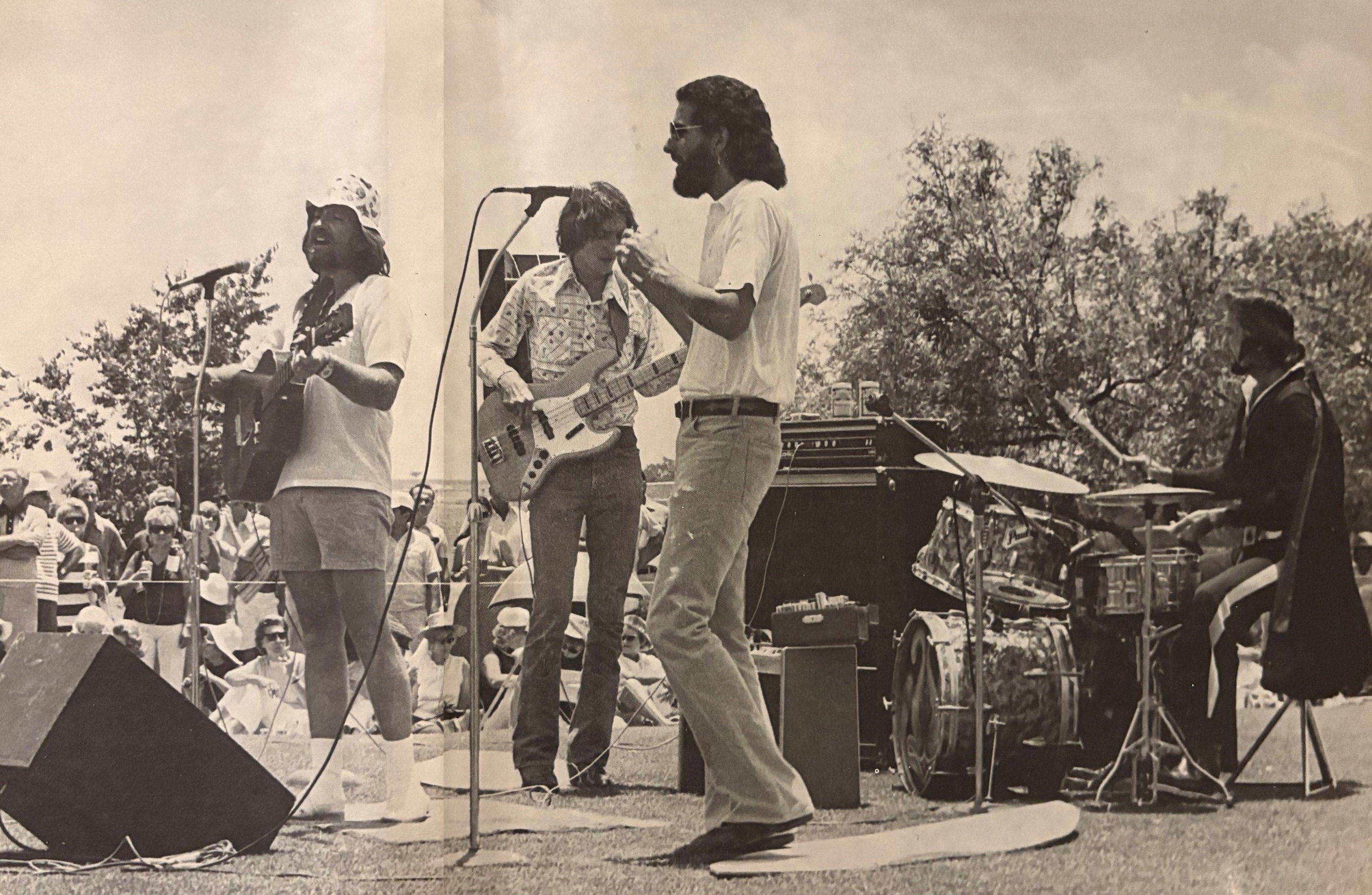
Featured image of Willie Nelson, Bee Spears, Mickey Raphael, and Paul English playing at the Onion Creek Club in 1973, from the Willie Nelson Songbook, 1976. Photo by Melinda Wickman.
“Hey, go call up Mickey. We need some harmonica on Saturday.”
“How’m I supposed to do that? Is there even a phone out here in Luckenbach? Anyway, I don’t have his number. What’s his last name again? Ray-field?”
“Yeah, Raipheld! Get him to come out here. Call Willie if you have to.”
In the 1974 edition of The Improbable Rise of Redneck Rock, author Jan Reid mentions that Willie Nelson had added to his growing Family band “a rock-oriented harmonica player, Mickey Raipheld,” whom he described as “a charter member of the so-called Interchangeable Band of Austin sidemen.”
Now, Lost Gonzo drummer Michael McGeary made clear to me that “the ‘Austin Interchangeable Band’ label was just some writer’s description of what was sort of a loose tribe of guys jamming informally. … We were never ‘interchangeable’ but for a few times,” and that was just going back and forth between Michael Murphey and Jerry Jeff Walker.
While this might hold true for the core Gonzo lineup, there’s a case to be made for the interchangeability – or maybe not interchangeability, but the seeming omnipresence – of at least one member of that tribe: namely Mickey Raipheld.
Well, make that Mickey Raphael – the guy with the harmonica in every photo or film ever taken of Willie since he grew out his beard. Raphael might be the red-headed stranger’s steadfast “secret weapon” (per a 1980 Rolling Stone article), but he’s also played on hundreds of non-Nelson albums and with artists ranging from Bob Dylan to U2 to Lionel Richie to Snoop Dogg. And in the mid-70s, if an album came out of that Dallas-Houston-Austin triangle, there’s a pretty good chance Raphael’s name was on it somewhere.
—
[Jerry Jeff Walker’s eponymous 1972] “brown” album is where you’re first credited as “Mickey Raipheld.”
Mickey Raphael: Ray-fee-uhl. Well, I pronounced it “Ray-fee-uhl.” That’s the way I grew up with it. But, you know, people didn’t know how to spell it, and they’d put a “D” on the end of it, or….
Do you still say “Ray-fee-uhl,” or do you say Raphael?
MR: No, I say Raphael.
Is “Ray-fee-uhl” the actual way to pronounce it?
MR: Probably not.
[laughter]
MR: Well, I don’t know. I don’t know, you know. The painter… is he… it depends, you know?
Yeah, yeah. OK, so they spelled it that way on the brown album, and then they just went and did it again for ¡Viva Terlingua! I always wondered how they could have gotten it wrong, because Raphael seems like such a normal name – but now I guess I understand.
MR: It wasn’t like there was a production coordinator, you know, figuring out what the credits were. It was all word of mouth. “Who played harmonica?” “Mickey Raipheld played harmonica.”
You’re from Dallas, right?
MR: Uh huh. I went to Hillcrest High School.
Did you spend much time at [famed coffee house/folk club] The Rubaiyat?
MR: That was my whole entrance into music, The Rubaiyat. That’s where I met B.W. Stevenson, Michael Murphey, Ray Wylie Hubbard. Donny Brooks – the harmonica player that kinda taught me – was my first real mentor. I went there just as a patron, you know, when I could drive. I was always going there, listening to music, and then ended up becoming a musician and sitting in and playing with people there. So that’s where I cut my teeth. There and The Cellar.
I don’t know The Cellar. Where’s that?
MR: Oh, that was a real shithole downtown rock-and-roll club that was open all night. There was one in Fort Worth and one in Dallas. It was a rock club, and I played with a guy named Mike Ames who was this biker cat, and we played from 8 to 8:30 and 4 to 4:30 … AM.
Wow.
MR: Split shift.
So that’s your first gig?
MR: Yeah, that would’ve been my first real gig.
Did you ever see Jerry Jeff at The Rubaiyat?
MR: Yeah, uh huh. I think I did. I mean, if it wasn’t The Rubaiyat it was when we went to Austin. You know, that’s where I met B.W., and that’s how I started playing with him.
At The Rubaiyat?
MR: Yeah.

Looking at Discogs, I saw that the first album you were on is by someone named Roger Young.
MR: Roger Young? Never heard of him.
Really?
MR: Yeah.
It lists your first credit as Roger Young and the Reason Why.
MR: What year?
‘69, so you would’ve been young.
MR: Well, I was a senior in high school and I was doing demos and stuff. You know, just going over to the studio and doing demos. So that might’ve been some local band, because I was playing on a lot of commercials and [with] local people. I have no idea who that is.
How old were you when you started playing harmonica?
MR: Teenager. 15. I would go over to Sumet-Bernet Studios and would just kind of hang out when they were doing sessions, and if they needed a harmonica player, they would call me in to play.
Is that how you ended up with, uh… do you remember the band Patchwork?
MR: Yeah, they were around playing local clubs and stuff like that. I didn’t remember until you mentioned it. Did I record with them?
Yeah, it looks like they were one of your first credits. And I noticed that two of the names there show up on B.W. Stevenson’s first record [which Mickey was also on], so I thought that might have been a connection. Because there was a guy named Ed Shook and somebody named Appling – last name – on the B.W. record.
MR: Oh, Shane and Kitty [Appling]. This husband-and-wife team that were playing around Dallas, and I would sit in with them. That’s who Ed Shook was a guitar player for. They got signed to RCA about the same time that B.W. did, but I was touring with B.W. His was my first real record, you know, with a label.
You met Willie Nelson at [legendary University of Texas football coach] Darrell Royal’s party in ‘72, and he asked you to sit in – so you started sitting in with him.
MR: In ‘73 I started playing with him. I’d left B.W. in January; he didn’t have many gigs, and I had one gig with Willie and he got pissed at me for taking the one show with Willie. And so I quit. So it was probably March or April of ‘73.
And this was all before [Nelson’s breakthrough album] Red Headed Stranger, so I guess Willie hadn’t quite blown up yet, right?
MR: No, not at all. I didn’t even know who Willie was, really.
Really?
MR: Yep, nope. I mean, I kind of knew. I had no country background at all; I didn’t know anything about country music, but I knew about “Night Life” and “Funny How Time Slips Away” through Ray Charles or Al Green, you know, those versions. Or Aretha. I had no experience with country music.
But you slipped right in with his band, no problem.
MR: Yeah.
It seems like at that point you were playing with everybody in the scene.
MR: Yeah, I mean, there was so much music in Austin. Even when I was with Willie, for several years we could go out every night and find a different bar or club to play. So I would just go sit in with whoever was there: Rusty Wier, Ray Wylie Hubbard, Willis Alan Ramsey. A lot of singer/songwriters. Uh, Guy Clark. When I was living there I was working for Willie, but he didn’t tour all that much. So we had a lot of downtime.
It seems like your dance card was always full – like you just had stuff going on all the time. I’ve seen pictures of y’all playing at the Onion Creek Club, and there was a car dealership gig, right?
MR: Well yeah, we’d play when the new cars would come in. We’d play in a flatbed truck in front of McMorris Ford; I remember that because it was so off the wall.
Did you have any competition in town, or were you the harmonica player?
MR: Well, Kim Wilson came later, you know, with the [Fabulous] Thunderbirds.
Did he play around much before the Thunderbirds?
MR: Well, he played with the Gonzos some, too, but he’s strictly a blues player. You know, traditional blues, and that really wasn’t my bag. I would go to Antone’s to listen, you know – I wouldn’t play there so much. I’m a huge fan of Kim’s; I think he’s the best there is out there. But there weren’t a lot of harmonica players. Donny Brooks was in New York at that time.
When you played on Jerry Jeff’s self-titled album in ‘72, did you just drive down to Austin from Dallas for that?
MR: Yeah, yeah. I was going to Austin a lot because B.W. was playing the clubs down there.
How did you end up playing on that record? Did Jerry Jeff just come to you and say, “Hey, I’ve seen you with B.W.,” or did you seek him out?
MR: Well, we were all hanging out, so everybody knew everybody, you know? And I’d be at gigs. Everybody went out every night and hung out and jammed in clubs. You just make yourself available and maybe you’ll get that call. So he might have just said, “Do you wanna play harmonica on this? Just come by the studio.” But [the studio] was just like a big garage, you know; I don’t know if there was gear in the place or if they had the mobile truck outside.
The building you’re talking about was Rapp’s Cleaners, and you all recorded direct to tape. There was no mixing board.
MR: Yeah, right. And I just played the harmonica on a couple of songs or something. But I love Jerry Jeff. The guy that played harmonica with Jerry Jeff on his records was the guy that taught me how to play.
Oh, is Donny Brooks on his earlier records?
MR: Uh huh.
I’ll have to dig back into those older ones. I knew I’d come across Brooks before and sensed some kind of similarity with the way you played.
MR: Definitely, yeah.
So, ¡Viva Terlingua! – were you only at the Saturday show, or were you also there during the lead-up week?
MR: I was just at the show, and I barely remember it. I just remember the place was packed, and I remember going in and playing on a couple of songs and hanging around, you know.
Did you consider it to be just another gig?
MR: No, it was very cool. I mean, Jerry Jeff Walker was the biggest guy I could play with at the time; he was the coolest thing going. That was either before I got with Willie or just about the time I was getting with Willie.
Is your lack of memory of it just from it being fifty-something years ago?
MR: Yeah, I think so. Plus, I wasn’t involved that much. I mean, I only played on a couple of songs. So I wasn’t in the band, you know; I was just sitting in on a couple of tunes. Mainly just being around, making myself available. You have to hang out a lot, and, when you’re not really part of the band, or an integral part, you’re just kind of icing on the cake. You’ve gotta be there for one or two songs, but it takes all day. It’s an all-day hang.
So you drove out there on the Saturday, then?
MR: Yeah.
In the big picture in the gatefold of ¡Viva Terlingua! – the one where you’re all hanging around the potbelly stove – it looks like everybody except for McGeary is wearing the same clothes they have on in Jim Allison’s pictures [taken at the concert]. It made me realize that the photo was taken, what, just a couple of hours before the show?
MR: Probably, yeah.

So you just show up on Saturday, they get everybody together to take that picture, and then a couple of hours later y’all are doing the show. And then did you drive home that night?
MR: Yeah, there are no hotels in Luckenbach!
Since Mary Egan seems to have been there all week but then left sometime before the show, I thought maybe they brought you in to just swap harmonica for the fiddle. (Egan is in the Saturday photo, so maybe she simply didn’t play on “Up Against the Wall Red Neck” and “London Homesick Blues” at the show – a possibility I wasn’t thinking of but that is implied in Mickey’s response.)
MR: No, there was a space for everybody. I didn’t play on every song, so [Jerry Jeff] specifically knew what he wanted harmonica on. It wasn’t just like a jam where everybody was playing. I was playing on “Old Time Feeling” and “Redneck Mother” or whatever. I’m not on every song on the record.
No, you’re just on the two taken from the show, so you are on “London Homesick Blues.”
MR: Yeah, I guess so. There was some choreography involved; there was some method to the madness, you know. Jerry Jeff would make the call, what he would want you to play on.
Interestingly, one of Jim Allison’s shots shows Gary P. Nunn on the drums, and I don’t know where Mike McGeary was, but it seems like people were moving around and trying different configurations.
MR: Yeah, that’s the way it was. I mean, people would just… different people would play on different songs.

Did you have anything to do with A Man Must Carry On in ‘77?
MR: No, I didn’t play [with Jerry Jeff] that much; that was the only thing I did with him. Well… Terlingua and the sepia record.
I can’t remember where I read or heard this, but did you start out wanting to be a singer?
MR: Me? Fuck no.
[laughter]
You know what – maybe it was Willie joking. Maybe it was that… there’s a video….
MR: Oh yeah, I sang that one stupid little song called “Fishin’ Blues,” and they would make me sing it, but I did not have any ambition to be a singer.
It’s on your website, isn’t it?
MR: Yeah, but it’s mainly just meant to be humiliating.
[laughter]
I grew up on [Willie’s] Stardust. It’s hard to believe that album was on the [Billboard country] charts for ten years [literally, from 1978 to 1988]. Is that the biggest record you’ve played on?
MR: Probably not. Mötley Crüe [“Smokin’ in the Boys Room” from Theatre of Pain] is probably the biggest record I’ve played on.
Oh, that’s right! How did that happen? How’d you end up on a Mötley Crüe record?
MR: Well, I had played on the Blue Öyster Cult record [Mirrors], and the producer [Tom Werman] called me. I think they were gonna originally get Paul Butterfield, and he wasn’t available, so they called me. I was in L.A. at the time.
Did you know Mötley Crüe?
MR: Oh yeah, sure; I was friends with them. I moved out to L.A. at the end of the 70s because I was working with Emmylou [Harris]; I was living at her house.
Were you in her Hot Band?
MR: No, but I was around during that time, and I was playing on the records.
I read that you recently did your first headlining concert.
MR: Well, I did a show at the Brooklyn Bowl in Nashville last year.
Was that in support of an album, or….
MR: No, just the owner of the Brooklyn Bowl has been wanting me to do a gig, and I never wanted to do a solo gig, and he finally talked me into it and I thought it might be interesting to do. I had some ringers come out and play: Chris [Stapleton] sang a song, and T Bone Burnett, and Jason Isbell, and Margo Price, and Shelby Lynne. And Bill Evans, who played saxophone with Miles Davis in the 80s; he was part of the core band. We used Stapleton’s band.
You’ve got a couple of solo albums, right?
MR: I have one.
Uh, is that Hand to Mouth?
MR: Yeah, uh huh.
What was that Red River Valley record?
MR: That was something that Cracker Barrel put together and just hired me to play the songs, so I don’t consider that my record at all. In fact, my name’s not even on it. I mean, it might be as a credit, but it’s just, you know, harmonica favorites or something.

Across your entire career, do you have a favorite performance?
MR: Well, the Highwaymen. And with Willie and Wynton [Marsalis] was great. We did two records. They’re the best; they’re live. Wynton and Norah Jones – a whole Ray Charles tribute [Here We Go Again: Celebrating the Genius of Ray Charles] – and then the other was just blues stuff [Two Men with the Blues]. Probably the best records I’ve ever done.
Mickey’s currently splitting his time touring with both Willie Nelson and Chris Stapleton.
-30-

Leave a Reply