
Featured photo by Gary P. Nunn, from Becky Crouch Patterson’s book, “Luckenbach Texas, The Center of the Universe, The Story.”
“The first time I saw Hondo Crouch was in 1964 or 65 at the old ‘11th Door’ Club in Austin, Texas.”
So says Jerry Jeff Walker in his liner notes for 1973’s ¡Viva Terlingua!, but Jerry Jeff didn’t seem to ever care too much about getting his facts straight. Maybe it had something to do with the truth being more important than facts, like Frank Lloyd Wright said. Or maybe, like in the Torah, there’s neither early nor late in his storytelling. Or maybe there just weren’t any fact-checkers in Texas in 1973.
Whatever the case may be, it was March of 1966, and 11th Door owner Bill Simonson had Jerry Jeff playing a double bill with Dow Patterson (not “Paterson,” as Walker has it spelled in the very next line (maybe there were no proofreaders in ’73, either)). Dow knows the date because The 11th Door had just opened (in November 1965), and it was the week of Jerry Jeff’s birthday (March 16).
A few years earlier, Patterson had made some records in the vein of heartthrob-era Ricky Nelson, but by 1966 he was an Austin folk singer. Walker was also a folk singer, albeit a wandering one described by a friend as an “itinerate footloose” whose “security is insecurity” and who had just that week finished composing the classic-in-the-offing “Mr. Bojangles.” Simonson would end up often booking the two together, saying Dow was the only performer who could get along with Jerry Jeff.
(Patterson would also make the first-ever recording of “Mr. Bojangles” when he invited Walker over to his apartment and captured a performance on his Wollensak reel-to-reel. That tape is currently housed at Texas Tech University in the Dow Patterson Collection.)
Double bills at The 11th Door ran from Tuesday to Sunday, and Hondo showed up for the Saturday show during that initial engagement. While he wasn’t yet “HONDO CROUCH” — owner, “Sunday mayor,” and clown prince of world-famous Luckenbach, Texas — he was still Hondo Crouch, popular local character and humorist, running a goat ranch out near Fredericksburg with his wife Shatzie and writing folksy dispatches as “Peter Cedarstacker” in The Comfort (Texas) News. He was also Dow’s father-in-law (Dow having recently married Becky Crouch).
At some point in the evening, Hondo, ever the showman, got up on stage between sets (or the stage got under him, as Jerry Jeff would have it):
“Hondo was story tellin’ and singin’ Mexican love songs. Doin’ Hondo, to the great joy of all the children gathered there.”
Foremost among these “children,” Jerry Jeff had just turned 24 and was utterly awed by this “old” man, who was all of a whopping 49 years old.
Hondo wouldn’t even recall this meeting later, but Becky and Dow made friends with Jerry Jeff and brought him out to the family ranch one evening. Per Becky in her book Hondo, My Father:
“A New Yorker, a pale night owl musician, [Jerry Jeff] came wearing rimless milk-of-magnesia blue sunglasses and a blue satin shirt. He devoured three helpings of one of Mama’s prize-winning country dinners. ‘I knew he was a guitar player,’ Hondo recalled later, ‘because he was hungry.’ … Ever since, [Jerry Jeff had] claimed Hondo as his ‘Old Man,’ his compadre.”
According to Walker himself in his autobiography, Gypsy Songman:
“Hondo’s gentle nature appealed to me the first time I met him, in ‘66 [See? -Ed.]. And he must’ve seen something in me, because we hit it off right away. … When I got back to Texas in ‘71, I immediately sought out Hondo to see what was going on with him and Luckenbach. … I would play songs around the potbellied stove in Luckenbach, and Hondo would sing something in Spanish or maybe do a poem…. We’d drink longnecks and tell stories all night long, usually winding up at the old Hill Country ranch house to watch the sun come up. It was new and fresh for me, and I was completely alive in this environment. … I had the feeling I had come home after all this time. … For the first time since I had hitchhiked out of Oneonta [New York], I was putting down roots, in my own restless way.”
He told Becky, “I wanted to be more like Hondo. I needed a little more of his goodness and he needed a little more of my badness.”
Hondo was in the business of making impressions on people. Songwriter Guy Clark first crossed paths with him almost a decade earlier than Jerry Jeff. As he remembered in Luckenbach’s Monthly Moon newsletter in 1976 after Hondo’s death:
“I first met Hondo in 1958. We were down at Rockport at his sister’s house. [Friends] George Hill, Lola Bonner and Hondo were singing Mexican songs. It was the first time I was ever at a passing around the guitar. … Now it’s a custom under the trees at Luckenbach, but it was brand new to me then.”
Jerry Jeff and Guy got to know each other in 1965 at a Houston club called The Jester. They hit it off, and, a few years later, after Clark and his wife Susanna had moved to Nashville, Jerry Jeff stopped by their house, and, as he told Tamara Saviano in her book about Guy, Without Getting Killed or Caught, “We all sat around talking and drinking some beers … and then Guy said: ‘I’ve had a breakthrough. I’ve written something.’ … The first song he played me was ‘Old Time Feeling.’ I thought: That’s really good. That’s put together.” He asked Guy if he had any others, and Guy played him “L.A. Freeway.” Both songs ended up on Walker’s eponymous 1972 album.
When Jerry Jeff started casting around for material to fill out what would become ¡Viva Terlingua!, Guy played him “Desperados Waiting for a Train.” Walker called it “the most solid song [he] had heard in a long time.”
Later, in 1975, when Clark released his own debut album, Old No. 1, Jerry Jeff would write this in the jacket notes:
“… Guy writes
Of old men
And old trains
And old memories
Like black & white movies
Etched
No, carved like crow’s feet
In the corners of his past …”
“Desperados” — one of those “black & white movies” — had its genesis in 1941, when Guy was born way out west in Monahans, Texas, where his grandmother Rossie ran the Clark Hotel and sold moonshine on the side. She had a boyfriend named Jack Prigg, who’d been a wildcatter in his younger days before settling down with Gulf Oil. The Clarks all considered him family, and he was a father figure for Guy, especially during the years when his biological father was away in the Army. Jack doted on Guy from the day he was born and would take him around to the oil fields to show him off to the crews.
Guy told Saviano:
“One time I was with Jack when an oil well was blowing out. They struck oil and it blew the racking board right out – a real gusher. I remember standing next to that rig watching it happen, oil splattering everywhere and the smell, and Jack’s running around in every direction. To me, as a kid, he was a real desperado, the real deal.”
Jack would take Guy to the movies, the barbershop, and the local pool… hall, as his mother later discovered, where Guy would sit and drink a Coke while Jack and his friends bullshitted and called their shots. Not only that, but: “We used to go to the Gulf Days picnic in Odessa in Jack’s ‘38 Packard, and he’d drink beer all day. … I drove the car home. I was just a kid, before I had a driver’s license, driving back to Monahans at thirty miles per hour.”
When Guy was in the sixth grade, he and his immediate family left Jack and Rossie waving goodbye in Monahans and headed out for Rockport, all the way across Texas over on the Gulf of Mexico.
In 1970, the same year that Hondo bought Luckenbach, Jack Prigg died of natural causes. Guy had gone to see him a few days before he died, and I’m guessing he played and sang Jack’s favorite song, the old cowboy standard “Red River Valley” — he basically says as much in “Desperados Waiting for a Train,” the song he wrote in remembrance of Prigg.
“Desperados,” as recorded by Walker, would become a gold-standard template for Texas singer/songwriter ballads in the decades to come. Lyrically, it has an antecedent in Tom T. Hall’s “The Year That Clayton Delaney Died” — a number-one country hit from 1971 — but musically it trades the jaunty, grating production of Hall’s single for the pathos of the Stones’ “Wild Horses,” also from ‘71. It gave Jerry Jeff something he could really sink his soul into.
In the middle of August 1973, Jerry Jeff and The Lost Gonzo Band gathered in the Luckenbach dance hall, opened all the windows, prayed for a breeze, and plugged in. From Walker’s book:
“We spent a whole day on ‘Desperados Waiting for a Train.’ As we played that one, I noticed that Hondo picked up on the lyrics. He heard the message. At that time, most of the music played around central Texas was dance tunes and old country standards. Play-on-words lyrics and cowboy swing. Superficial stuff, nothing that cut deep to the heart of life. But this was real. Some day, someone was going to sing this over somebody’s grave. Hondo stood next to me with his eyes closed, listening to every word. It’s the take we used on the record.”
It begins with Jerry Jeff strumming a gentle country blues on his acoustic as Sweet Mary Egan falls in with her fiddle and a familiar-sounding melody. Then the first line drives it home — “Yeah, I’d play the ‘Red River Valley’” — and interpolates that melody wholesale … but just for a line; after that, it’s all Clark.
He drops us in a kitchen where a 70-year-old man is pondering fate and crying about whether or not every oil well he’d ever drilled had gone dry. A young boy (the singer/narrator) is there trying to soothe the man’s wearied mind with a song, because, as he tells us: “We was friends, me and this old man.”
Over the next couple of verses we get glimpses/scattered memories of the adventures of the old man and his “sidekick,” living their lives like they were in “some old western movie.” Always in the back of their minds, however, is that train coming ’round the bend. (True to form, Jerry Jeff has swapped the order of these verses from the way Guy wrote them, but whether or not it was intentional he doesn’t miss a beat, and it works.)
Somewhere between the third and fourth verses, the kid moves away and begins a life, only to look back one day to find the old man “pushing eighty / got brown tobacco stains all down his chin.” It’s a shock; his friend is “one of the heroes of this country / so why’s he all dressed up like them old men?” It’s no longer — and hasn’t been for a while — the two “desperados waiting for a train”; it’s “a desperado waiting for a train.”
The grown kid gets himself together and goes to visit the old man, knowing that this is it: “We closed our eyes and we dreamed us up a kitchen / and played another verse of that old song” — “Red River Valley,” of course:
“From this valley they say you are going
I will miss your bright eyes and sweet smile
They say you are taking the sunshine
That has brightened our pathway a while.”
Then they wait together one last time. “Jack, you know that sumbitch is comin’.”
And, sure enough, here it comes, picking up speed: The song goes out on a full-blown Lost Gonzo Band rave-up, with Herb Steiner and his pedal steel blowing that long, lonesome whistle into the night. (I wonder how many Hill Country ranchers sat up in their beds at the sound of that unexpected, otherworldly train in the distance.)
There’s no doubt the song held significance for both Jerry Jeff and Hondo. Jerry Jeff made the connection explicit in his liner notes for ¡VT! by dedicating them “To One of the Hero’s [sic] of This Country”:
“I remember the time we had gone to Fredericksburg in his truck and as we pulled up to a light about eight or nine kids were crossin’ the walk way. As they passed in front of the truck they broke out in hollering and waving ‘Hi, Hondo, Hi Hondo, Hi, Hi.’ Hondo waved back and shyly grinned towards me and said, ‘I made a little speech at the schools last year and the kids all remember me.’
“… During the last encore of the Saturday night show, the whole band took turns makin’ verses to ‘Goodnight Irene.’ Gary Nunn’s verse went something like: ‘I came down to Luckenbach to find out / If Hondo was a legend or a man / I found out he’s more than a legend / He’s one of the Heroes of this land.’ Gary gave Hondo his guitar. I broke mine, so I gave Hondo my heart.”
That same week, lawyers were busy finalizing Hondo and Shatzie’s divorce. I asked Gary P. Nunn if the band knew what Hondo was going through at the time. He said, “We were unaware of that, you know. Maybe Jerry Jeff was, ‘cuz, you know, [Hondo would] stay up all night with Jerry Jeff every night. Jerry Jeff never went to bed the whole time we were there.”
Per Becky’s book, “Jerry Jeff was recording his latest album, [1977’s] A Man Must Carry On, at Luckenbach at the time of Hondo’s death. It became a beautiful tribute to him. Right before the end, Hondo had stayed up all night, several nights in succession, with the enduring drinkers and pickers. The marathon jam session took its toll.”
Hondo died of a heart attack on September 27, 1976. Becky recounted to me: “When we called Jerry Jeff to tell him Hondo had died, he just dropped the phone and never came back.”
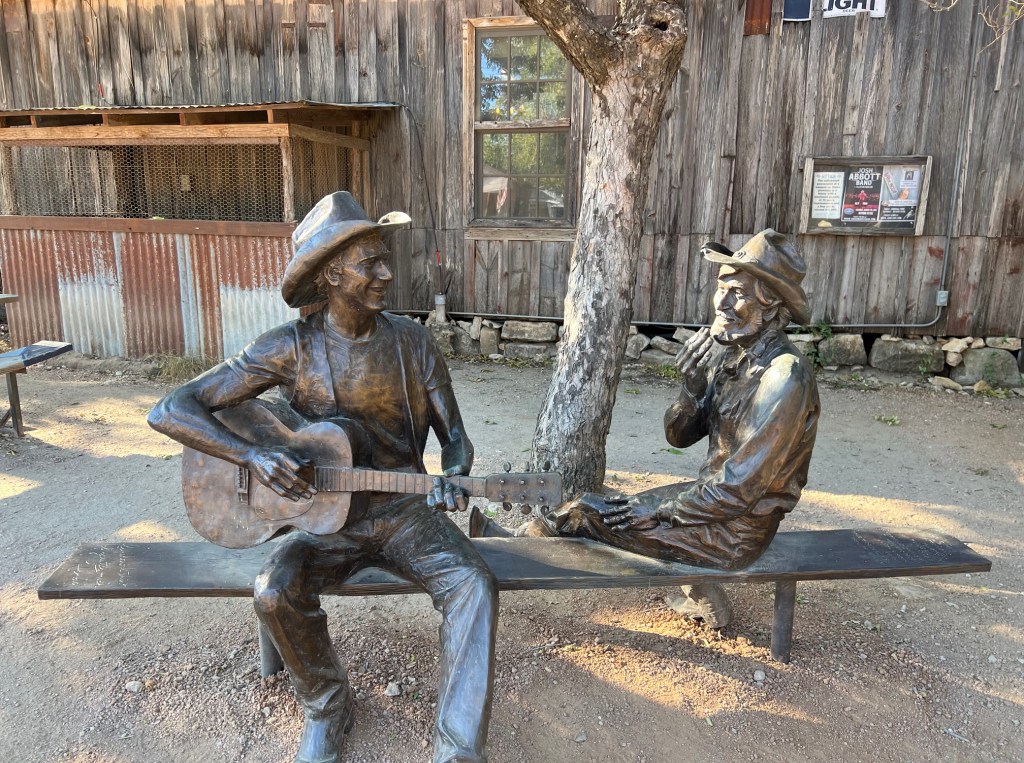
In 2022, a statue of Hondo and Jerry Jeff was unveiled in Luckenbach. Inscribed on it are words Walker wrote about his friend in the liners to A Man Must Carry On:
“In times like these
It is with personal pride
I can say
I knew a man
Whose own security
Gave him the freedom
To enjoy life
With its simple
Wonderful
Everyday
Magic”
-30-


 ¡TERLINGUA BLOG!
Leave a comment