
A lean, grinnin’ dude with a nose that’s been busted and will probably get busted some more slips out the door of Electric Lady Studios in Greenwich Village dressed in a floral-print western shirt, faded jeans, cowboy hat, and boots that were custom made in Austin, Texas. He pauses on the sidewalk to get his bearings.
Jerry Jeff Walker isn’t really too interested in the mixing session going on back there in the studio, even though it’s for his own MCA Records debut (and his seventh record overall), the 1972 gem Jerry Jeff Walker. He’s mostly gotten himself free of the humorless bullshit that is professional studio recording, and he’s happy and completely content to leave the finishing touches to someone else.
He convinced MCA to let him record most of that album in what used to be an old dry cleaner’s business in downtown Austin: a simple recording space where they “didn’t even have a little ol’ board.” Everything was straight to tape, and it was a rather loose, funky affair. Loose and funky enough that the label insisted the results be cleaned up in New York, where Jerry Jeff ended up recording or re-recording half the tracks. Regardless, he’s feeling like a new man, and he’s not about to go back to the old ways of doing things.
Per the liner notes that he would pen for JJW:
“Once a year I’m supposed to go to one of the record factories in Nashville-New York-L.A.-motel-hamburg-red light-pick sessions. They call it ‘cutting tunes’ (sounds like surgery). (You Gentlemens are going to stay here till you do it right, you hear?) … I made up my mind a couple of years ago that I was going to have more of my friends and the good-time miles be part of my ‘Record.’ So, whenever someone mentioned ‘studio,’ I hid. I bought another round, and I looked for a hole to disappear into.”
The hole he’s disappearing into this time is 6th Avenue. The old stompin’ grounds where he’d spent plenty of time in the 60s as the perpetually footloose folkie who would write “Mr. Bojangles” before slippin’ on down to Texas at the dawn of the next decade.
As he strolls, his thoughts go tumblin’ back to the days when the world was love and life was but a thought, but a whistlin’ little bird eases him out of his reverie right around Bryant Park, and, on a whim, he turns left onto West 43rd and spies what looks like a Winnebago with two wheels up on the sidewalk and a whole mess of cables running through a window of The Town Hall, an old Midtown concert venue. Once he gets closer, a glance at the side of the truck reveals the legend, “Dale Ashby and Father Sound Recorders.”
“Now isn’t that something?” he thinks to himself. He knocks on the side door.
A young, headphoned hippie sticks his head out, looks to either side, then back at this cosmic cowboy standing in front of him and says, “Yes?”
Jerry Jeff asks, “Are you recording something?”
Dale Ashby responds, “Yes, we’re doing a symphony date here tonight.”
Walker: “Could you drive this studio to Texas?”
Ashby’s forehead wrinkles. “Uh, sure.”
“How ‘bout Luckenbach, Texas?”
“Well, if it’s on the map, we’ll get there.”
From Walker’s 1999 autobiography, Gypsy Songman:
“Within days, I was tossing Dale’s business card across the desk in the office of my manager, Michael Brovsky. I told Brovsky I was going to do the next album in Luckenbach.
“‘Oh,’ I said, ‘and there’s no electricity in Luckenbach. Well, there’s electricity, but when you open the beer cooler, all the lights flicker.’”
Now, I love this account of their first meeting, and I hope with all my heart it’s true, but this was all “fifty fuckin’ years ago,” as Dale and his old compadre Len Ognibene (pronounced ahn-yoo-baynay – “a good Italian name”) would remind me. And, though Walker tells this tale in his book and other places, he seems to be contradicting his own contemporaneous liner notes for that next album, ¡Viva Terlingua!, in which he states: “Michael Brovsky, my ‘Doctor Gonzo’ of Walker Escapades Inc., found a great mobile unit ‘Dale Ashby and Father’ to drive from New Jersey to Luckenbach, Texas and record whatever we played.”
I asked Dale and Len if they could please confirm the truth of the truck-on-the-curb story.
—
Dale Ashby (audio engineer/owner, Dale Ashby and Father, location recording): Um, I have no idea.
Len Ognibene (stage manager, Dale Ashby and Father, location recording): There is no doubt that we had done classical events in New York City. We were based out of New Jersey, so it’s entirely possible that he had an opportunity to observe us working in New York. You mention that’s his claim in the autobiography?
In [Walker’s] book, he says that he was walking down the street, and he saw a remote truck with cables running in through a bathroom window, and he stopped, and I guess talked to you, Dale, and said, “Hey, could you come to Luckenbach and record me?” And you said, “Where’s Luckenbach?” And….
Len: Oh, I read that quote! That’s not quite how I remember it, however.
How would you say it started?
Len: That was Brovsky.
Dale: Michael Brovsky was a producer in New York City. We were doing a lot of work in New York City … and Michael Brovsky got our name from somebody at one of the studios as a location truck and called me directly and wanted to know if we wanted to go to Texas. At which point I said, “What?”
Len: “Texas?”
Dale: Basically, we worked out a deal to go to Texas and spend a week or whatever we spent down there. And it was very minimum requirements, just: “Whatever happens for music, record it.” So when we went down there we went down there wide open.
During the week of August 13, 1973, Jerry Jeff Walker and the group of Austin musicians that would soon come to be known as The Lost Gonzo Band set up in the old dance hall in Luckenbach, Texas (a hamlet of about ten buildings on a little loop) with hay bales as sound baffles, and got to work writing songs (“don’t you worry, something’s bound to come out”) and putting them to tape. By the end of the week, it was decided that a little shot in the arm was needed to top things off, so a concert was hastily arranged for Saturday. Judging from the recording, and by all accounts, it was a real banger.
Luckenbach (“population 3”) was, and still is, basically a little bend in the road an hour-and-a-half west of Austin and fifteen minutes east of Fredericksburg, Texas. Four years after ¡Viva Terlingua!, Waylon Jennings would make it famous beyond all comprehension with his 1977 megahit, “Luckenbach, Texas (Back to the Basics of Love).” The town was owned by a trio of friends that included Hondo Crouch, a popular local humorist whose business card read, “Imagineer, Authorized Distributor.” He was also Jerry Jeff’s best friend and something of a father figure to him.
How old were you in ‘73?
Dale: Erh….
Len: Uh….
[laughter]
Len: 22? 21? Something like that.
Dale: Early 20s.
Did you guys have any trouble finding Luckenbach?
Dale: Well, first of all, traveling in general was always a lot of fun, back in those days. ‘Cuz there wasn’t any GPS. There wasn’t, you know, “go to this location” and have it track. It was paper maps and map books and, you know what I’m saying, it was … an atlas.
Len: When we got there, we were hunting Fredericksburg, not Luckenbach. We went to Fredericksburg first and then went to Luckenbach.
Did somebody have to come meet you in Fredericksburg to take you to Luckenbach?
Len: No, we had the instructions; it was just in a different, weird order. We didn’t try to find Luckenbach first, which would have been, I would think, a more difficult situation.
Yes.
Dale: We found Luckenbach on the map.
Did you have any trouble getting the [recording] truck through there? Did those little dirt roads cause you any problems?
Len: The recording truck that we were using at that point was more like a large Winnebago than anything. It wasn’t like semi-sized at all. Dale bought the equipment, and we built [the recording setup] in the truck.
Dale: Understand, we were real young. Seriously young, you know? With long hair … hippies. We were totally ignorant of the situation we were in and the quality of….
Len: You’re being kind. We were in so far over our heads when we showed up to do ¡Viva Terlingua!, it’s a damn miracle we got it.
So, “Dale Ashby and Father.” Was your father there?
Dale: Yes. Myself and my father [Bill “Pops” Ashby], and Lenny, and we had one other fellow, David Tarbox, that was with us, and basically my father’s responsibility was the technical side of the truck: the tape recorders aligned, the rig. You know, if any problems came up with any electronics, he was the electronics guru. My job was mixing. Lenny and David’s job was the stage and microphone setup and dealing with the musicians …
[laughter]
Dale: … You know? Because there were a lot of people, and most of them were pretty high. You know what I’m saying? So, dealing with people at times took a little politics and a little understanding. And of course it was a different genre for us, too, coming out of New York City and all of a sudden we’re dealing with people that weren’t New York City people. But we didn’t stick out real bad, because we were kind of new to the industry, so we just kind of kept our mouths shut, did the job, and smiled a lot. You know what I mean?
Len: Dale’s father had location recording history at a time when the location recorders were the live lathes being cut into vinyl as the music was playing.
Dale: Yeah, my father worked at a radio station …
Len: It predated tape!
Dale: … worked at a radio station and would put microphones out at a concert some place and bring it back [by] telephone lines to the radio station. And my father would cut a vinyl disc of it as it was going on.
Len: Because that was the only technology available; that was state of the art at the time. So that’s where he was coming from. Dale was coming from an engineering position in New York, and David and I were studio musicians that were working through the production company that Dale was running. So we weren’t virgins when we hit for ¡Viva Terlingua!
Dale: The one thing we did have was good relationships amongst us, and figuring out [how to] make it work.
Len: It was a real good crew.
Dale: We’d learn on the fuckin’ fly.
Who’s Martin Lennard? Did he work with you? Or was he a remixer in New York?
Dale: A remixer in New York. Michael hired him to do remix work. I didn’t do that work on the album; he did. But it was my recording.
Len: The ¡Viva Terlingua! record that you have, does it have pictures on the inside? Do you have the album?
I do. I’ve actually got my dad’s copy of it, and it’s the one with the lyric sheet.
Len: It was a single album, but it was a folding cover, and the inside of the cover had many pictures.

I was wondering if y’all were in those pictures.
Len: No, as individuals, we were not in any of the pictures. However, the campsite is visible.
Yes, I saw the truck. Right.
Len: There’s a guitar leaning against the truck in that campsite photo, which was my guitar.
Oh, wow. … So, in one place I read that the truck was way over by [South Grape Creek, which runs through Luckenbach], but something else I read said the truck was kinda right up next to the dance hall. Do you remember how you had it set up?
Dale: We were right next to the dance hall. It was less than fifty feet from the truck to the inside where our stage box was where we plugged everything in. Real short run to the stage box.
Did you guys get there before [everybody else] did? Were you there a day before or something?
Dale: Yeah, we were there ahead of everybody. And Brovsky came in; he was there ahead with us to help us get settled and to get the townspeople to help us out and anything we needed or whatever, and get us set up and have the straw bales and hay bales delivered, so we had, you know, material to work with. So he was really instrumental in that first day or so, getting us settled in to the whole operation. He was also responsible for getting the food brought in. You know, you gotta feed the crew. It wasn’t a catering thing; it wasn’t like you think about big concerts. It was just, you know, go get fifty sandwiches and come back.
Do you remember, did you have any problems with electricity? ‘Cuz I know that the electricity source was supposed to be undependable.
Dale: Location recording, [the] primary thing is you pull the truck up, and the very first thing you do is decide where you’re setting up your stage box. And do you have enough footage to get from the truck to where the stage box goes. Next primary thing you do: Where’s the power? And I gotta have x amount of power, and especially when you get down to Luckenbach, Texas, where it’s hot, you gotta run the air conditioner, you gotta run the tape recorders, you gotta keep the truck at a reasonable temperature, or the electronics … this is analog; this is not digital. That’s a real important point. We were doing analog recording, not digital recording. We had a fucking [spreads arms out to signify “big”], you know, to get the analog recorders in that weighed God knows how much apiece, etc., etc. We were hauling a lot of weight around all over the country. So analog was … I’m still, to this day, don’t like digital. It’s just too fucking clean.
Everything I’ve read suggested that because Luckenbach was as small as it was, and because people didn’t really live there, maybe only a couple of people lived nearby, that there wouldn’t be enough electricity. But that wasn’t a problem?
Dale: No. I don’t remember it being a problem. We never had an outage; we never went blackout.
Len: Now, compared to digital, the equipment in analog is a much higher, voracious eater of amps. However, it still ain’t that much. Not when you consider the power drop into what boils down to a tourist community. Even then, that’s what Luckenbach was. So I don’t really know where … I don’t remember … I think we tapped into a box that was in the back of the stage area.
Dale: So, somewhere in the dance hall was a power breaker, sub box or whatever, that we tapped into. That we did a lot. Lot of shows we did, there wasn’t an outlet that we could plug into, so Pop, my father, would pull the face off of the disconnect or the breaker box, and we’d just….
Len: No! We didn’t do that; we talked about that. You don’t go into the breaker boxes and fuck around with the power.
[Dale smiles and all laugh]
Len: No, we kind of did it, in our memories.
[more laughter]
Dale: The point is, we got power however was necessary. Was it legal? Was it up to code? Pffft. But we got it. My father was the one who had the screwdriver with the burn marks all over it. And, you know, Hondo Crouch and everybody else at Luckenbach, the permanent crew, they were connected enough in the community [that] if they needed something they could make a couple phone calls and make it happen.
In [Lost Gonzo band member] Gary P. Nunn’s book [At Home with the Armadillo], he seems to suggest that it was his idea to do the hay-bale baffling, but did you already have that stuff set up before they got there?
Dale: Uh … I don’t really remember. And it might have been his idea, but it would have been us trying to figure out how to set the band up and get isolation between the microphones so, you know, we’d get good sounds. And it would’ve been something that, like … one of the locals like Gary or whatever would say, “Well, we can get our hands on a bunch of straw bales, and we can use those for baffles.” And that would’ve been, “Yeah, bingo! We’ll do that.” And then, next thing you know, here would come a pickup with fifty straw bales on it for people to sit on and dampers between the amplifiers and stuff.
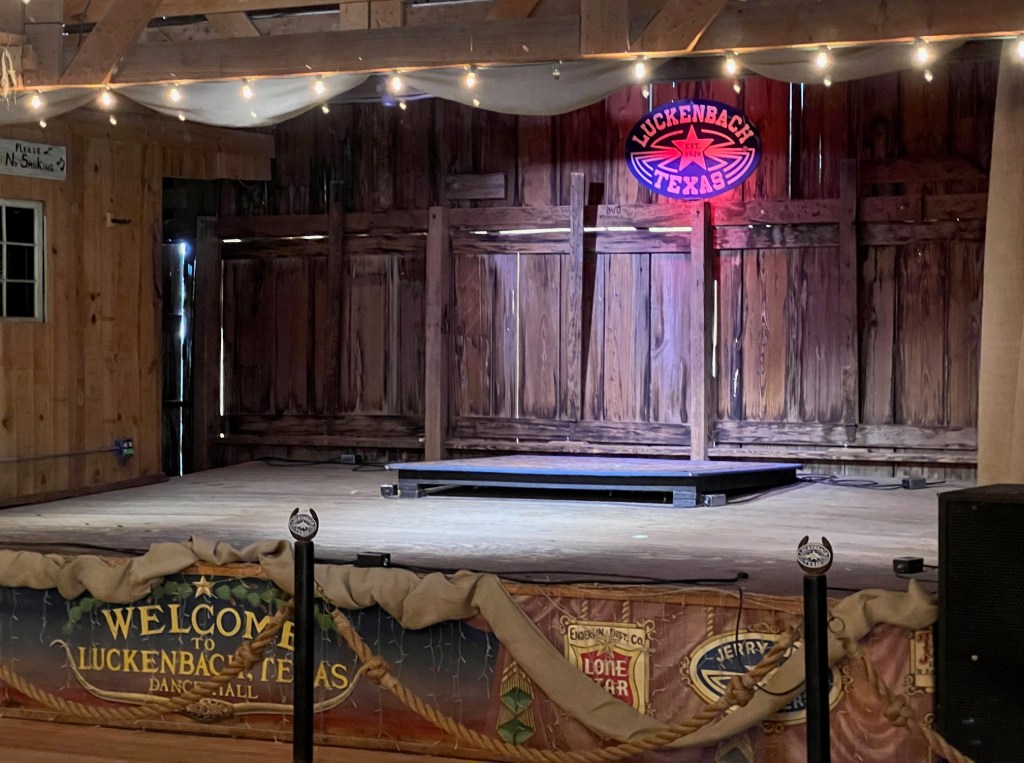
[In his book,] Gary P. said that the way you set it up is you would put Michael McGeary and his drums on the stage, and then you’d put Jerry Jeff with a mic in the center of a circle, and all the other musicians gathered around Jerry Jeff in a circle, and then you had the hay bales around everything. Does that sound right?
Dale: I thought the drums were on the floor.
Len: No, they were on the stage.
Dale: Lenny knows all this stuff better than I.
Len: That’s an accurate description so far as I can remember.
On “Gettin’ By,” the opening track, Jerry Jeff says, “Hi Buckaroos; it’s Scamp Walker time again. Tryin’ to slide one by you once more.” He [later] said that before it was “Hi Buckaroos” it was “Hey, you in the truck.” Y’all were a part of it. Do you remember any of that?
Dale: There were what we call “ins and outs.” In a studio before a song starts, the drummer taps or counts it off and the song starts. When you’re doing location recording like this, the microphones are open. And people like Jerry Jeff or whatever, they just lean into the microphone: “You ready in the truck? Are we doin’ OK? This is what we’re gonna do.” Just conversational back and forth between the two of you. And we had a little squawkbox, a little speaker, that sat out next to where the stage box was, where I could pick up a microphone and talk to the stage.
Len: It was two-way intercom.
Dale: Two-way intercom, exactly. So, it was open communication the whole time we were recording. So if Brovsky didn’t like something, he could ask them to stop and change it and start over again. Or Jerry could say, “OK, I’m ready to do this. Let’s do this.” You know, “Hi buckaroos” or whatever.
Len: And it was recorded. This stuff is all recorded.
Dale: ‘Cuz we ran the tape….
Len: We were being very conservative. It’s another one of those idiosyncrasies of live: If you get an artist onstage, and you have microphones up there, turn the damn mics on, ‘cuz you don’t know what’s gonna happen, and you don’t want to find out that you missed it.
Dale: Yeah, turn the tape recorders on. Soon as the artist walks onstage in front of the microphone, you turn the tape recorders on, because anything is liable to happen. And usually does. Some weird shit happens that gets cut off before it gets put on a record. Before and after. At the end of the song, when they hit the last chord of the song and let it resonate, and somebody goes, “Aw, fuck, man.” You know?
Len: What’s the point in live recording unless you catch all the bullshit?
[laughter]
Len: And there’s no audience on most of the scenarios that you’re describing. So conversation after the song was over would have been a natural thing to expect. It would be cleaned up in the editing process.
Dale: Yeah. As versus the Saturday night show, where, you know, they’re gonna treat it like a show, and nobody’s gonna … they’re gonna go from one number to the next number to the next number. When we were out there doing the weekday work, it was: Do a song, listen to the song, decide whether you’re gonna do another take of the song … it was like a studio layout, in terms of….
Len: It was an efficient use of the time. Once they got rolling.
Dale: Yeah, and if they did a really good one, they’d take a break, and they’d come back to the truck, and we’d do playbacks. So everybody could hear it … big time. You know, put together, mixed right, in terms so they could hear the balance between the instruments and whatnot, and see if they could, at that time, hear a fuck-up or hear something that made them want to do it over again. Or, turn around and say, “We ain’t gonna do it any better than that. Put it in the can. Let’s move on to the next song.”
Len: … Which Jerry Jeff was busily writing over in the corner because he didn’t have enough songs for the album.
Dale: Oh yeah. Well, that’s part of what happened: They ran out of songs, and they turned around to Gary P. Nunn and those guys and said, “Whaddya got that we can stick on this and fill the album out?” And that’s how it went.
In the opening, where Michael McGeary’s doing that kinda rim-click to start off “Gettin’ By,” it sounds like you can hear somebody in the background even saying something like, “Take six.” It’s hard to tell what it is exactly, but … do you remember, did most of these songs have several takes, or were they mostly done pretty quickly?
Len: All of the songs had several takes. There was nothing that was recorded off the first take that was used.
Dale: Typical studio-type session, where, you know, nobody was happy the first time. Everybody was still working it out. Working their parts out, etc., etc.
Len: These were, I mean … quite literally, some of them were brand new; those songs hadn’t existed the day before.
Dale: Yeah. They learned ‘em right there!
Len: And at that level, you know, a musician will lay out a particular line that they like, according to the chord structure, and another musician will like a line that is contrary to that. The counterpoint will be different. The harmony will be different. And you don’t know that until you perform it live.
Dale: It was a lot of on-the-spot creativity.
Len: Yep.
And considering how, say, even though Jerry Jeff probably already knew Guy Clark’s “Desperados Waiting for a Train” when he went in there … still, there were a lot of words. Do you remember, did he have everything memorized, or did he have lyrics in front of him?
Dale: Everybody had the chords written down for the song. Well, they’re all learning the song! And then Jerry had the words written down on pieces of paper. It was, you know, no audience, so they could do what they wanted.
Len: Exactly. No concern about video.
Sure. [Jerry Jeff] also says that during the recording of “Desperados Waiting for a Train,” Hondo was standing right next to him at the mic. Do you have any recollection of Hondo being right in the middle of everything?
Len: Absolutely.
Dale: Hondo was right in the middle of everything. When it was over, my father and Hondo would go over and sit in the bar and get half drunk together.
Len: Yeah. And drink Lone Stars.
Dale: It was family for ten days. It was just family for ten days.
That’s unbelievable.
Dale: It was [for] us, too! Scared the fuck out of us when we went down there; by the time we left we were all friends.
[laughter]
Dale: We went down to do a second one [1977’s A Man Must Carry On] ‘cuz we had so much fun the first time.
Len: New Jersey boys. And you’re talking about deep-country Texas, hill-country Texas? I can’t think of two things that would be …
Len and Dale together: … further apart.
[laughter]
Len: But, you know, at the risk of sounding philosophical, I have always found that if you treat people the way you want to be treated, it’s gonna work.
Dale: Yeah. And it brings everybody together, and, you know, all those clichés that follow.
This album feels like that. To me, this album feels like a community, you know?
Dale: Yep.
Len: Very much.
Dale: As versus a drug-induced studio album. I’m sorry, it’s the truth.
To me, it’s so much about community, and place, and atmosphere, and working with each other….
Len: The musicians themselves all got along very well. That by itself is a minor miracle. Because, I mean, who would you expect to have egos? Well, recording musicians. Usually means there’s going to be some kind of contrast of opinions. And there was creative give and take, but nobody got their pants in a wad. I don’t think for the whole week nobody got their pants in a wad.
Dale: When Jerry ran out of music to play, and turned around to the band and said, “Whaddya got?” All of a sudden the band got, “Oh God, we’re part of this!” Gary P. Nunn was gonna get a chance to showcase himself. You know? Lightened up the atmosphere and added to the atmosphere.
I’ve read stories where maybe Jerry Jeff could be a little bit difficult to deal with at times, but you’re saying you didn’t…. Well, what was your experience with them as people, just in general?
Dale: For the most part, you know, I mean, you’re talking about high-geared musicians and high-geared A-type personalities all trying to put their best forward on this project, etc., etc., so they could make a “big” record, hit record or whatever you want to call it. Part of the business of location recording is being able to handle the personalities of the musicians, the producers, the people that are involved. You just keep a low temperament through the whole thing. ‘Cuz starting out, everybody’s real nervous, everybody’s real uncertain about what’s gonna happen. And then after a couple of days of getting into it, everybody starts to relax and the family thing starts to happen. But the first couple of days have a tendency to be a little, uh, edgy. You know? And I don’t mean that so much in a bad, negative way … just people, you know, “I don’t know you; what do you want from me?” You know what I’m saying? And, yeah, Jerry at that … like I say, there was a lot of chemistry on site. So, you know, people would have a tendency to get pretty whacked out and get moody. Let’s put it … let’s leave it just that. Get moody. And, you know, it’s the kind of thing, you just let somebody, “OK, OK, not a problem; I’ll take care of it.” And just let people … give people space.
In “Gettin’ By,” there’s some really good backing vocals in the chorus. Were the backing vocals all live or did you do overdubs?
Dale: No, we overdubbed the backing vocals.
Len: … We did them at the live location.
But it wasn’t all one take?
Len: It wasn’t all performed simultaneously.
Dale: Now, the Saturday night live show … that was all done altogether.
Len: That was, what you heard is what you got.
On “Sangria Wine” there’s gang vocals, where it sounds like twenty people are singing. Do you remember if that was overdubbed or was that a live setup?
Dale: If it was a gang thing, probably not.
Len: There were two or three vocals that occurred real time, and the balance of them were overdubbed in additional tracks. For example, Joanna Vent had probably three tracks of herself: one original that was with the performance of the band and then follow-ups.
One other thing I was thinking about with the recording is, uh … the album’s got this really thick atmosphere, you know? And you can hear crickets and stuff, right?
Dale: Oh, yeah. We were real careful about catching the atmosphere around. In my mind, one of the highlights was they had rehearsal sessions where they were learning songs and stuff like that, and we were doing soundchecks, all in the dance hall. But then there were lots of breaks and people would get away to work on a part or whatever. We ran microphone cables across the trees over to the area behind the bar (you can see that on the album with people sitting around behind the bar) and hung microphones from the trees. Lenny hung U87s from the trees. Real sensitive, so we could hear everything. That was the crickets and stuff that you heard; that was all background noise that we used. A musician could sit there with an acoustic guitar, play and sing without having a microphone and a bunch of technology in his fuckin’ face. Or two or three people could sit down and pick together without having technology or have somebody running around setting a microphone up in front of them and spoiling the whole atmosphere. They could just walk over, sit down and play, and we were back in the truck with stereo microphones recording it on two-track tape to get all that color and the whole thing. Inside the bar we had microphones that were just out of the way and out of sight and out of mind. Most of it never got used, but the point is there were times when it was just a lot of fun to eavesdrop on the crowd.
I’ve read stories about how the song “Wheel” was done the day after the concert, on Sunday. According to [Lost Gonzo band member] Bob Livingston’s anecdote [in Lone Star Music Magazine], they were all, you know, smashed out of their gourds, and they showed up and Jerry Jeff’s like, “We’ve got one more song to do.” And it sounds like [Bob’s] saying it was a Sunday morning, but I swear I hear the crickets in that, too. Do you remember, were the crickets all day long?
Dale: It was summertime, and they just never stopped.
Len: The cicadas is what they were. And he’s right, I don’t ever remember them not making noise.
Dale: To the point that it was background noise, and we didn’t hear it anymore after awhile.
[¡Viva Terlingua! is] one of the most wonderful sounding albums I’ve ever heard in my life.
Dale: Thank you.
It’s part of what’s sucked me in all my life listening to it. And it’s funny, just this last weekend a good friend of mine – we were in a band together in high school – I was talking to him about ¡Viva Terlingua!, and he said, “There’s no way that was all done there. It sounds like it was in the studio. It sounds too good to be remote.”
Len: No.
Dale: No. I was a studio engineer in New York City for more time than I’d like to confess to, and when I got the chance to get out and do location recording, it was all about catching … uh … my father’s favorite phrase was, “We caught the smoke.” You know? The idea was, all that background color…. Ambience! It was the number-one importance to us; [when] we’d go in and do a concert at Carnegie Hall or Luckenbach, Texas, or whatever, was to catch the ambience around to make you feel like you’re really sitting there in the audience in front of them. And your problem is: studio engineers, audio engineers; everything is so isolated. You know, here’s your guitar; the guy sat down and spent two hours and recorded a guitar track. The basic band did another session, and it patched it all together. And there’s no interplay between the musicians … well … not as much interplay between the musicians. (I need to be careful here that I not let my opinion get ahead of my good sense.) Because once I started doing location recording I was convinced that it was the only way to really get honest, honest music. Not only honest music from the musicians, but honest recording of the music from the musicians. This is what it really sounded like from the perspective of the audience. Location recording’s a really interesting approach.
Len: Those two concepts are often at odds. In Luckenbach, in the dance hall, when we miked up the musicians that are actually doing the playing, the goal here is to get only what they are doing through the microphone. You don’t want leakage; you don’t want any of that stuff. That’s for later. The microphones that we strung around in the environment itself is where all of that stuff came from. It was the mic that was hanging out behind the bar. It was the mic that was over by the picnic tables where everybody went to drink beer on a hot, Texas summer day. That’s where all that…. None of it was made up. None of it was artificial. None of it was produced after the event.
Dale: There were a couple of late-night sessions where it wasn’t all the band playing, just Jerry singing a song or Gary P. Nunn or whatever doing a song, and it was quiet. You know, this is Luckenbach, Texas, there’s no truck traffic, there’s no…. The long and short of it, when you opened up a microphone at nine or ten o’clock at night, there was background noise. Crickets and whatever that you heard in between the singer singing. You know? And that’s, to me, that’s the magic of what it was. That’s the magic of location recording, irregardless of whether it’s in Luckenbach or Carnegie Hall.
Len: That’s why we did exclusively location recording for years. It’s what happens in your stomach when you’re listening to it live and when you play it back it still sounds the same way. It was an interesting thing to do for a long time.
Dale: I have a concept for you to chew over in your brain that we paid a lot of attention to but not many people did: When you record a group in a studio, you record your drummer, you record your guitar player, your piano player or whatever, and then it comes back to remixing with stereo. You put one guitar here, you put the drums here, organ over here, whatever. You can do the layout anyway you want because there’s no interface between the instruments. When you do location recording, if you visualize in your head the stage with the band on the stage, here’s the drummer here, here’s the bass player over here, here’s the organ player over here, and then you’ve got the microphones, the lead microphones in front. And you’ve got the fiddle player here, the guitar player here. When you lay that out in stereo … all those microphones all listen not only to what’s going into them but the stuff on either side of it. The peripheral music. So, if you take somebody that’s on the right side of the stage, who’s playing, and when you go to remix and put them on the left side of the stage … the peripheral sound, the leakage, into his mic is in the wrong place. The part’s over here, not over there.
Len: It’s out of phase.
Dale: So it’s out of phase, and it makes the mix muddy. Real muddy. What makes Luckenbach a real clean sound is that wherever the musicians were, in remix they got put back into exactly the same positions so any of the leakage on the microphone is natural leakage from the musicians. So when you’re listening as if you’re an audience … you’re listening to what was actually done and how it was staged, you know? It may not seem like much, but I’m here to tell you it makes a big difference if the person mixing a live record lays it out the same way it was recorded.
Len: It makes it mandatory for him to have some … to support this concept … you gotta have a video, a picture, a something. You gotta know how the band was laid out on the stage. And for my money, this is one of maybe three things that define the difference between studio albums and live albums. It’s critically important, you know? All of the microphones on the stage in a live event are picking up something of what every other microphone up there is picking up, to some degree. The amplitude might be lower, you know … there might be a resonant frequency. But if you start screwing around with the pan position in a stereo image, you better make it look like what the band did.
Dale: Or it’s gonna be real confusing to your brain and to your ear. And [how] it comes out in your ear is muddy. It’s the best word I can use for it. It just sounds muddy. That’s because the leakage, the peripheral noise in each of the microphones, is not set to what actually happened. It’s not real; it’s fake. Most of the live recordings done during those years, they’d get back to the studio and the studio engineer would mix it with no concept of what the original layout was.
Len: “I want the guitar over here.” “No! Put the bass over here!”
Dale: Yeah, really! It’s just, you know, everybody thought, “Well, it’s insignificant.” Well, yeah, in essence it is; it doesn’t sell more records or less records. The difference that it makes … you just said to me, “It’s the cleanest record you’ve ever heard.”
Yeah.
Dale: That says to me, we did it right.
I’d say so!
Dale: Yup, and that’s paying attention to how the mics are positioned when it’s remixed and all that kind of stuff. That was the point that I was trying to make.
So, the sessions before the show, I’m not talking about the Saturday night show but the sessions the week before, were those recorded at any hour of the day? Or were they mostly at night? Mostly in the morning?
Dale: The general routine was: We’d get up in the morning; nobody got up early, early, early. You know, we’d get up and go to the little restaurant in town and have breakfast with the whole band, not with Jerry Jeff usually….
Len: It was the German food in Fredericksburg that was worth the journey.
Yeah, I’ve had it.
Dale: We were all junked up on German food, and then we’d all go out there and just kinda get things back into operation again, get the lights turned back on, tap the microphones just to make sure everything still worked, blah, blah, blah, blah. And then we sat out at the table on the cover, the picnic bench outside the unit or whatever and just hang out. And about this time, Brovsky would walk over and say, “OK, we’ve got a couple of ideas for a couple of songs we’re going to start working on,” and he’d gather up the band and get the band hustled into the dance hall, get people sat down and tuned up, and, you know, it was real loose. Real, real fucking loose, you know? To the point of … he had his hands full the whole time we were there keeping everybody moving in a direction, because people would wander off, you know? To say the least….
Len: Some of the miracles of modern chemistry had something to do with it.
Dale: Oh Jesus, God. Lots of modern chemistry.
So Brovsky was doing a lot of babysitting.
Dale: Big time babysitting. You got it.
[Looking at the photos on the album cover] I don’t actually know what Michael Brovsky looks like.
Len: You see, in the center….
Dale: The kid with the violin?
Len: He’s talking to Michael Brovsky.
Oh, OK.
Len: They called him “The Bear.”
Do you know who the guy is over to the left, in the “Terlingua Chili Cook-off” … he’s got a white t-shirt and a cowboy hat?
Len: Oh, he was not one of the musicians. He was one of the….
Dale: Locals?
Len: Well, I don’t know local. Could’ve been a hanger-on from Austin. Over behind his hat are two people sitting at a picnic table that are most definitely hangers-on.
Dale: There were a lot of people that came and went while we were there, a number of people, and it’s kind of hard to separate … ‘cuz it was advertised to the locals, so we had a lot of curiosity seekers roll through. And, of course, there were the groupies and hanger-ons and whatnot. For the most part, during the day it was pretty quiet. At nighttime, it got pretty busy because the barflies would show up to have drinks and listen to the music as we were practicing and warming up. … I’d like to add something here. Do you know the name Rex Foster?
I do.
Dale: Guitar player. Singer/songwriter. Yadda yadda yadda. In all essence, he was our local host while we were in town. He’d do things like take us out to the bat cave and watch the bats come out. You know, he was our local “color” person.
Len: We were in the lean-to, behind the recording truck, next to the dance hall, and we were trying to get a campfire running. And we were New Jersey boys. “Campfire? What, are you kidding?” You know? “Show me where the stove is.” Anyhow, he watched us, and he was just amused at our complete ineptitude. So he came over with a full-size axe and was helping us get the proper split and divisions of the firewood and everything else. And that was when he was traveling in, and often camped in, an old school bus called “Agarita Rose.” And Agarita Rose was a … uh … I almost remember what the inside looked like; let’s put it that way. Rex Foster. He was a great guy.
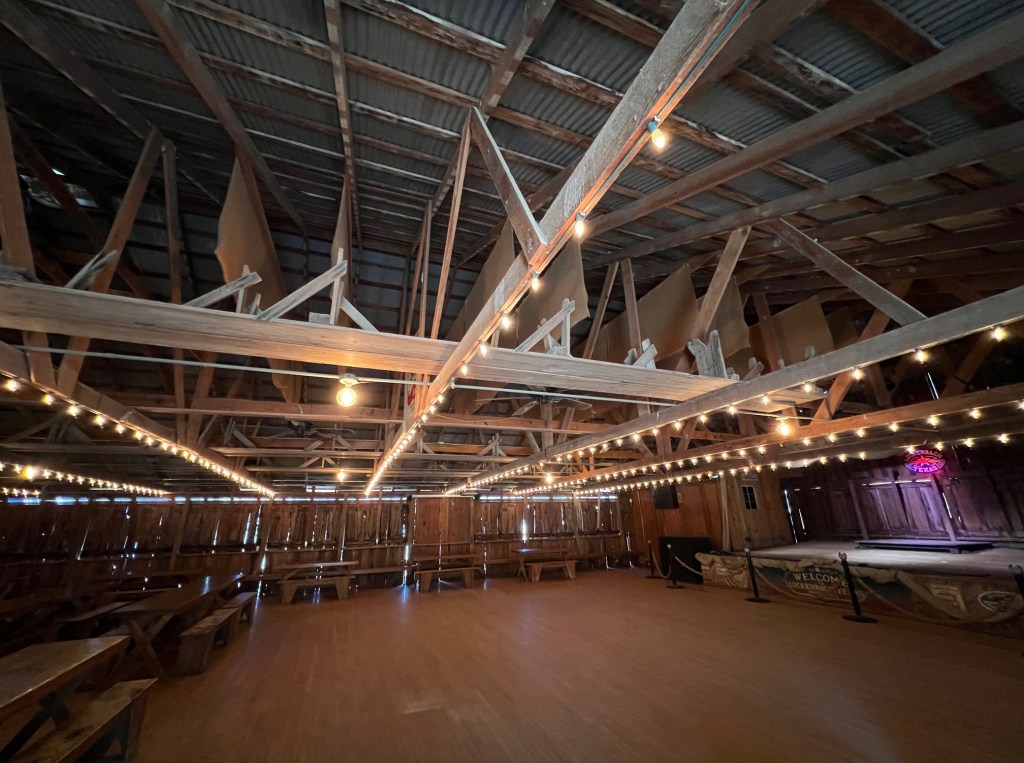
So when you had those mics set up everywhere for ambience the whole week … for the show on Saturday night, did you have mics hanging from the rafters? How did you get the crowd noise?
Dale: Audience mics? Yeah. You know, we obviously had to….
Len: Standard operating procedure is to hang audience mics.
Dale: We always looked for the background. Whether it was crickets, or people applauding or saying, “Wow, that was great! Hope they do this….” You know? We always looked for that kind of side stuff. Now, I don’t remember, [looks to Len] did people come into the dance hall, or were they outside? ‘Cuz it was an open-sided dance hall.
Len: Oh, no, they were in the dance hall.
Were the windows open? Those side windows?
Len: Yep.
There were people outside, too, then, right? Probably both?
Len: Absolutely.
Dale: Oh yeah, there was a bigger crowd than would fit in the dance hall, that was for sure.
Would all the crowd noise have been the inside part, or did y’all have mics on the outside crowd as well? Probably everywhere, right? Based on what you’ve told me.
Dale: Well, yeah, we still had the mics hung up over the bar in the back, and, you know, we would have spread stuff out to get as much reaction, audience reaction, as possible.
Len: Most likely, however, the primary microphones for audience would have been the ones within the dance hall.
Dale: That’s where the most “Yay!” is gonna be.
Was it as loud as it sounds on the record?
Dale: Yes.
Like, were they that boisterous?
Dale: It’s a tin-roof dance hall; it got fuckin’ loud. You know what I mean? And it’s small, and people elbow to elbow. Yeah, it’s gonna be loud.
Len: I was running the house PA for the crowd. And, uh, I like it loud.
[laughter]
Dale: It was a good time.
What are your memories of the show? Was it a good concert? There’s only the two songs [from the concert] on the record, so I don’t know what the rest sounded like.
Dale: Well, it was kind of funky because, you know, Jerry Jeff’s reading the fucking words to the song as he’s singing to the audience, you know? Like I say, they were all brand-new songs for most everybody in the band. So, it was a live recording session, is the way they actually labeled it.
Len: It was as loud and as boisterous as your imagination wants to fill you in on.
Dale: Yeah.
Len: And probably then some.
Dale: Pickup trucks all over the fuckin’ place. All the way down the road. All just … people came. It was amazing how many people … you know, it’s out in the middle of fuckin’ nowhere in Texas, and, just, people showed up.
Len: Wasn’t in the middle of nowhere for the people who lived in the area. Area being 60-, 70-mile radius.
Yeah, I lived in Austin for most of my life, and it’s not that bad a drive, obviously. I have noticed, of course, that the two songs from the show that got recorded, or that made it to the album, were not his originals. Which made me wonder if his originals weren’t quite ready [as live numbers], I guess, for the album.
Dale: I don’t know; I wasn’t there for the mix sessions. I’m sure they mixed everything that we did. The studio stuff, or the weekly stuff, as well as the show stuff and then just sat down and said, “Well, this one wasn’t performed as good, but the energy is higher in this one ‘cuz the audience was there.” You know?
Len: It wasn’t selectively mixed. The mixing session would have been for every piece of content that was turned in. They would have done their best effort on all of it, and then made choices.
And, of course, what am I saying? The two songs that did make it were brand new as well. You know … they just weren’t his.
Dale: Yeah.
But, I mean, hell, Gary P.’s [“London Homesick Blues”] was practically done on the spot almost, right?
Dale: That turned out to be a good song live, heh heh.
Len: That ended up being the Austin City Limits theme song for years and years and years.
Yeah. And then the other one was Ray Wylie Hubbard’s “Redneck Mother.” Which I’ve read that they had to have him finish the lyrics over the phone. They called him and said, “We need another verse.”
Len: I believe that. I found myself, oh, five years ago now, doing a live recording at the Tennessee State Museum in Nashville, and the featured artist was Ray Wylie Hubbard. All those years later here he is and he’s sitting down next to me having lunch at the Tennessee State Museum. We completely ignored the rest of the people in the entourage for the rest of the afternoon ‘cuz we were telling war stories.
Have either of you read Jan Reid’s book The Improbable Rise of Redneck Rock?
Len: I have not; no.
Jan Reid was a Texas writer, and he said that when he went to Luckenbach in the weeks after ¡Viva Terlingua! that there was a guy sitting in the bar, and he was playing a tape of the full concert. Do you know if there are actually any tapes of that full concert? I assume you taped the whole thing, right?
Dale: Oh yeah. We taped the whooole thing. And we also, besides running 16 track, we had two stereo Ampex machines that we would run lap to lap. That was our safeties. Ah, and it was a monitor mix that I was listening to at that time. And those tapes were….
Len: But that person should not have had access to them. That was a very controlled scenario.
Maybe it was a bootleg. Maybe they bootlegged it themselves.
Len: It would have to be.
Dale: Yeah. Now, we did make some cassettes at the time, but those would only have gotten handed to Michael Brovsky. Would not have handed that to anybody else. That was … he had proprietary [ownership of] the material. And we woulda got fired on the spot if we gave that material to somebody else.
Do you know if that stuff exists anywhere? I guess they’re just in the MCA vaults somewhere, maybe?
Len: [to Dale] Where was it mixed? MCA?
Dale: Uh….
It was mixed at Advantage Sound?
Dale: Oh yeah, Advantage. That would be where Brovsky would work, yeah.
Len: [to Dale] And that was Lennard, wasn’t it?
Dale: Yeah.
Len: OK. Then the owner of the tape would have been able to use their studio as an archive location or could arrange archive and protection on his own, independently of anybody else. Because he owned the masters. Literally.
So, who exactly owned the masters?
Len: It would have been Brovsky and/or the company he was working for. Most likely MCA.
Dale: Yeah, if MCA was paying the bills, bottom line, MCA owned the tape.
Len: And they get real testy, ha, ha. Rightfully so, you know.
Dale: Yeah, ‘cuz Brovsky was an independent producer, and he’s gonna go to a record company and make a deal for this album. They’re gonna give him front money, etc., etc., you know, and pay for his expenses and pay for the recording truck that had to come in and whatever. They’re the ones who ultimately own the product.
Len: The deliverable of record, as far as ownership is concerned, is the tapes.
Dale: It’d go everything to Michael Brovsky. We were relieved of the responsibility as soon as we handed everything off to him.
Len: Oh, we wanted those tapes gone. Because as long as they were in our possession, we were liable for their existence. As soon as those tapes had the opportunity to be someplace else, we got ‘em there. Now, in this particular case, we weren’t talking huge budgets, but some of the shit that we did in New York City … if tapes got lost, there was a lot of money involved. A lot of invested money to make the music occur.
Is mobile recording more expensive than studio time?
Dale: No. Way cheaper to do a location recording than to do a studio album. Studio album may be a hundred, hundred-fifty hours of studio time at two or three hundred dollars an hour. Location recording, you get a truck for two thousand dollars a day. And then ten days later….
Len: Back then.
Dale: Heh, yeah, back then.
Len: Fifty fucking years ago.
Dale: It was significantly cheaper to do it live. Most musicians didn’t like doing live recordings because they couldn’t get the chance to go back and fix something. When you do a live recording, you’ve got the ambient noise that we were talking about, with each microphone. If all the sudden you punch in a new vocal you haven’t got the ambient noise. And for those people who pay attention to the details, listening in headphones or whatever, all of a sudden it gets real dry. For that punch in, for that overdub.
Len: It’s very hard to take live stuff and lace it with studio stuff for the reasons he’s talking about.
Dale: It’s much cheaper to record live than it is to do it in the studio. Now, you still have a studio bill … you know … you still have to go to the studio and mix it, but there’s no outside input mixing. It’s all, “Here’s the tapes from the concert.” And you just lay it out and put it back together again.
Talking about how hard it is … you know, when you listen to, say, Waylon Jennings’ “live” stuff from the 70s, a lot of times it just sounds totally fake, right? The crowd noise will bump up super loud, and then it cuts out immediately….
Dale: There was a lot of bullshit that we had to fight our reputation through. Of stuff that was out there that was done poorly, done fake. But, at the same time, there were a lot of excellent live recordings that were being done. At the time this was done, there were only four of us in the United States doing location recording. There was Wally Heider on the west coast; there was Record Plant on the east coast; there was a group up in Connecticut that was working; and there was us. That was it. There were four of us in the whole fuckin’ United States.
Len: There was a small company called Fetco that was on Music Row in Nashville. I remember it because I interviewed with them for a job! Heh heh.
Dale: There wasn’t a lot of competition.
Len: No, no. And the ones that did it half the time did it shitty.
Dale: And a lot of times, rather than, uh … a lot of location recordings that were done, they’d literally go into a studio, pick the equipment up from the control room, pick out the microphones, load it in a truck….
Len: A rented truck.
Dale: … a rented truck. And take it some place and set it up and do the recording. Those, generally speaking, were terrible location recording concerts, because they weren’t … you know, wrong microphones…. The people that were engineering were studio engineers….
Len: The truck was not sound contoured, you know.
Dale: Yeah. A lot of it was haphazard and nasty.
Len: It was lack of attention to detail. We didn’t do anything that was remarkable; we just did it carefully. It was standard knowledge, but it was difficult to find people that would carry the details that far.
Dale: And, in the case of Jerry Jeff and Michael Brovsky … people like Wally Heider and Record Plant, they were doing the big-time, huge rock and roll stars, and it was, you know … Michael had to find somebody that was a little lower key to take to Texas. You weren’t gonna get Wally Heider to go to Texas and hang out for ten days. Not for the money we charged ‘em. Heh heh.
So, in terms of being tricky with [“live” recordings] – I don’t actually consider this being tricky – but I’ve read that that little tag at the end of “London Homesick Blues” is actually from take one and the main part of the song is take two, and that it was spliced perfectly together to sound like they picked [the song] back up [at the end]. Does that sound right? ‘Cuz I’ve tried to hear it, and I cannot hear anything that sounds like it’s spliced together.
Dale: A good mixer, somebody that’s really good at what they’re fucking doing, puts an album together, and something like the last tag … an edit that’s done correctly you’ll never fucking hear.
And that would be Lennard, then, right?
Dale: Yeah.
Len: He was good enough.
Dale: Yeah, well, that’s why Michael hired him to do the mixing.
Do you know who would’ve done the sequencing? Would that have been Brovsky or Lennard?
Dale: That would have been Brovsky. Well, it would’ve been Brovsky and [Jerry Jeff] working together, saying “put this song first, put this song second.” That would have been a collaboration between the producer and the artist.
It’s such a wonderfully sequenced album. Even though it seems a little strange, ‘cuz you’ve got the two songs from the show separated, but the way the whole thing is sequenced just flows perfectly in my mind.
Len: I think it’s one of the best albums that I’ve ever heard, regardless of category.
Dale: Yeah.
Len: For all of the reasons that you’re talking about.
Dale: And it wasn’t just a single person. It was Jerry at his best, Michael at his best, Dale Ashby and Father at its best, the musicians at their best…. It just was a real magical coming together of people. And we all fed off each other, so it made everybody’s job better, because everybody else’s job was better.
Len: Well, it was strong enough that here are the three of us fifty-some-odd years later enjoying the conversation about its existence. So, yeah, it was great stuff. It was magic stuff.
Dale: And fifty years later, we survived it.
Len: Ha, yeah!
Dale: We’re still alive.
Len: It’s the old joke: If you remember it clearly, you weren’t really there.
So, you guys worked with Jerry Jeff on a few albums, right?
Dale: Well, for two or three years we did all of his location stuff.
Len: I think on A Man Must Carry On I actually got mixing credits for some of that.
Oh yeah?
Len: Yeah, I believe so. They spelled my name wrong, but, yeah, I believe so.
For the remote recording, then, I suppose you’re the guys who did that “Stereo Chickens,” right? On A Man Must Carry On?
Dale: Yep.
I noticed last time I was in Luckenbach that there’s a piece of private property just across the little creekbed, and there were chickens in there. Was it just local chickens that had wandered onto the property?
Dale: They wandered around the place. Mexican chickens that they’d throw corn out to, or whatever. It was just … local color.

This album [holding album up to the camera], Too Old To Change … do you know this one? This says that one of the tracks was recorded at the Walker house by Dale Ashby and Father. Do you remember doing that at Jerry Jeff’s house?
Dale: Yes, yeah, we went to Jerry Jeff’s house. That was much later, though. That was probably three or four years later.
This is, I think, ‘79.
Len: And Terlingua was ‘73?
Terlingua was ‘73, and I think A Man Must Carry On is ‘77.
Dale: Like I said, Michael hired us to do a lot of work with Jerry.
When was the last time that either of you went to Luckenbach?
Len: Whew, I went down there … good Lord. Easily eight or ten years ago.
Dale: For me, it was probably forty, forty-five….
Len: You never made it back, did you?
Dale: I don’t know that I ever really made it back [after A Man Must Carry On]. [¡Viva Terlingua!] worked out so well, they decided to see if they could duplicate it. Personally speaking, I don’t think the second album had the originality and the spontaneity of the first one. I think the first one caught everybody by surprise. Really, honestly. The second one was … again, it was still Luckenbach, and it was still laid back, and it was still, you know, a good record, but we….
Len: It was not a cusp moment. There was no karma.
Dale: Yeah. It was different, OK? Everybody was still having fun, still playing music, and enjoyed doing the first one so much that doing the second was just a treat to do. Just … it’s a revival type of deal. Anyhow, in the process of doing it, we did the same thing [as we did for ¡Viva Terlingua!]: We brought hay bales in for baffles or whatever and set it all up, and everybody sat down and used them for chairs. Winds up, the field that they took ‘em out of had brand-new, fresh chiggers in the whole fuckin’ field. The next day, everybody had chiggers, right up to the top of their neck.
Len: We’re not talking fifteen or twenty chiggers.
Dale: We’re talking a hundred.
Len: I had three or four hundred. It looked like somebody had stripped me from the waist up and taken a red pen and went dit-dit-dit-dit-dit-dit-dit….
Oh, God.
Len: And that was everybody.
Dale: Yeah.
Len: Including the musicians.
Dale: Anybody that was working inside the dance hall, sitting on the hay bales … it was just loaded with chiggers. And I remember walking into the bar, and Jerry Jeff had his shirt off, and he looked … he had a lot of chigger bites.
[laughter]
Dale: He looked like he was suffering. So, consider Brovsky in the middle of this whole thing. Here’s the producer spending thousands and thousands of dollars to bring all these people together again, yada, yada, yada. And, all of a sudden, he’s got no band, he’s got no star, his crew is out in left field with chigger bites and whatnot … he picks up the phone, and he calls this guy in … [to Len] Austin, Texas?
Len: Yep. A doctor.
Dale: Yeah, calls a doctor. Comes out in a World War One….
Len: No, World War Two. It’s a MASH truck.
Dale: Yeah, a MASH truck with a red cross on it and all that. He shows up and starts shooting up everybody with calamine lotion and B1, trying to get the crew back to working again. It wound up we only lost one day where everybody was just out of it, but it was hysterical, this guy coming in.
Thank God that didn’t happen during ¡Viva Terlingua! That would’ve botched it up a bit.
Len: It was not just an annoyance; we had so many chigger bites that we were ill as a result of it. Physically ill. And that was the only time I’d ever had that many chigger bites. So I had no history: “Oh, gee, you’re gonna get really sick.” Yep. Yep, that was the case. Heh heh.
Dale: So that was the second album. That was a main event on the second album.
That second album was put together, I guess … Hondo had just died, right? ‘Cuz it’s sort of a tribute to him, isn’t it?
Dale: Yes.
So, did you record all the … when they would read the live poetry and that kind of thing?
Len: Yeah, when Hondo was reading his poetry? Yeah.
Oh, that’s right! OK, OK, you know, actually, let me back up to that then. ‘Cuz I was thinking of when Charles John Quarto reads a poem he wrote about Hondo, and that’s on A Man Must Carry On. And then there’s the “Luckenbach Moon,” which is what you’re talking about, that Hondo recorded, but it sounds like that was maybe recorded during ¡Viva Terlingua!, and they just didn’t get to put it on the record. Does that sound right?
Len: Oh, I don’t remember.
Dale: I don’t, either. Now, it was, again, the bar and the backstage behind the bar, or the, um, little drinking area behind the bar, we had it totally miked. So it might very well have been that this guy was gonna sit down and read something….
Len: No, it sounds on the record precisely like a formal reading into a microphone.
Dale: My memory’s not good enough to give you an exact answer.
Len: I remember the recording; I don’t remember which album.
You remember actually recording Hondo, though?
Len: Yeah, I remember Hondo actually recording something, yes. Now, that could very well have been part of what ended up on the editing floor. There’s no way of telling, ‘cuz I didn’t follow it through the mixing process; it was not our thing. But I remember distinctly Hondo reciting something and us recording it, but I just don’t remember what the project was.
Did doing ¡Viva Terlingua! give you bigger jobs after that? Was it kind of a calling card, or….
Dale: It was the first big show we went out on, in terms of money. We were doing one-nighters here and one-nighters here and one-nighters here, and this was the first contract of an album that we went out to do. When we got back from ¡Viva Terlingua!….
Len: It was the biggest job that we had done so far.
Dale: Yeah. And when we got back … word in New York City spreads real fast about everything, and, like I said before, there was only four or five people doing location recording in the whole United States. … So, you know, word spread when the live record came out. So what happened after that, I don’t know if it’s directly responsible ‘cuz of ¡Viva Terlingua!, but we started getting calls from places like Media Sound.
Len: Record Plant. That was back when simulcasts were just coming on the scene. We got tapped to do a lot of simulcasts.
Dale: Yeah, where it’s a live feed to radio. Yeah, that was a big thing.
Len: WNEW-FM out of New York City was the flagship FM station at the time, and that was where all the rock stars went to live. WNEW-FM. And they hired us to do, uh, shit … Renaissance?
Dale: Yeah.
Len: Hocus? Focus?
Dale: Focus.
Len: Um, and these were done at Carnegie Hall, Avery Fisher, Philharmonic….
Dale: And that gave us a reputation …
Len: … that pushed us over the top.
Dale: And from then on it was … once the unions in New York City, um … stagehands union get to like you, you start working. You start working a lot.
[laughter]
Dale: New York Jazz Festival every year. Etc., etc., etc., because, you know, a promoter … New York is a hard place to do a show. It’s an expensive place to do a show. So, a promoter or producer would call up Carnegie Hall and say, “I want to record. I got an act coming in in two weeks, and I want to record it.” The labor people, the stage people, at Carnegie Hall, the union people, would say, “Well, we trust this person, and we trust this person, because those are the only two people we work with. Do not hire this person, because we will not haul their equipment in to the stage.” I mean, it was hardcore New York, and we got off on a good foot with all the unions. So we got the chance to work.
I looked you guys up on Discogs and saw that you worked with [the likes of] Mel Torme and Bill Evans. A bunch of jazz kind of stuff, right?
Dale: A lot of jazz, a lot of country and western. We did a lot of gospel. A ton of….
Len: Harry Chapin. Elton. Focus. Renaissance. Dave Brubeck. Michel Legrand with Ron Carter and Grady Tate.
Oh, Ron Carter….
Len: If you are aware of Ron Carter, then you have a real good handle on the level of clientele that we were recording in New York. We did work at the Waldorf Astoria. We did work at Avery Fisher Hall and Carnegie Hall. We did part of the concerts in Central Park for all of those years. Paul Simon … Barry Manilow….
Dale: Yeah, double-platinum album with Barry Manilow at the Uris Theater.
Len: Uh, Laura Nyro. Joan Baez. Jim Gordon.
Dale: Now you know why [Len] worked the stage. He knew all the names, all of the people, you know. I was a, uh … 90% of the jobs that we took the location truck out on, I didn’t know the names of the people we were recording. I didn’t. I knew the producers, I knew the company I was working for, etc., etc. And I knew the headliner, but I didn’t know the people in the band, etc., and a lot of the shows we did at these venues, the people in the band went on to have gigantic careers, huge careers. So, it’s like, you know, Lenny had the details, and I sat in the truck and listened to the music and tapped my foot. I was a geek in the studio working behind the console. I was into the music, the quality of the recording.
Len: You were the nerd with the buttons.
[Dale nods his head; laughter]
Dale: … That liked to lean over and say, “OK, we’re rolling!”
Len: And the reason that that relationship developed that way was because I was a studio musician for Dale when he was an engineer in New York. That’s how we got together.
Dale: Yeah, I recorded his band.
Len: Yeah, we were trying to be rock and roll stars. Like everybody else.
Dale: So I would steal time at the studio at night when there was nothing else booked, and he’d roll in with the guys, and we’d sit there until three o’clock in the morning and fuck around, you know?
Are you still working in the business?
Len: I was out of the business for a long time, and about fifteen years ago I got contacted by a buddy of mine who’s in the visual arts, and he wanted to do a TV show. And years ago when I had come through and stopped at his house, I told my buddy that if he ever built a stage I would record everything that he did. So about fifteen years ago he built a stage, and I had to live up to my word. So I went out and I bought all the digital equipment. ‘Cuz I’d never done digital. And for the next fifteen years, we did a show called “Jammin’ at Hippie Jack’s.” It’s available on the internet. It was Americana roots music.
Dale: I got out of the record business when we closed out the location recording truck. Because after fifteen years, we were just … I was personally tired; my father was tired. The road is….
Len: Too many Holiday Inns.
Dale: The road is a hard … I wanted to start a family, and I wouldn’t start a family if I was still on the road because you’re never fuckin’ there and etc., etc. So, uh, basically, I wandered around in another business with my father. He did electronics, so we did that business for a few years. Then I was a project manager for building cell towers, and I did that for almost 21 years. And then six years ago, seven years ago, I retired and started a food truck! My oldest son built and started a distillery, making custom spirits, and he needed somebody to provide food service for his clientele at the distillery who were coming every Friday, Saturday night. And I was retired, so I built a little food truck. Old road dogs, you know, always have to be in some sort of truck. My music years were full and very satisfying but it came to a place where it was time to get real and have a family and a real job and all the rest of that stuff. So that’s what I did.
Len: When I was no longer involved doing the location gig, I went back to try and get what other people would refer to as a “real” job, and the experience of traveling on the road doing recording was discounted completely as the meanderings of a crazy hippie.
Dale: Yeah.
Len: No validity ascribed to it at any level at all.
No matter hit record or not.
Dale: No.
Len: It didn’t matter. … I don’t know if you’ve looked up Dale’s discography, but there’s more than one gold record that went through his hands.
Dale: Five gold records. A double-platinum record, and a Grammy, thank you very much.
Did you say a Grammy?
Dale: Grammy. Yeah, best gospel, traditional gospel record of the year. James Cleveland. Savoy Records was his record company. The gospel we did … for ten years, we did hundreds, literally, hundreds of little small gospel churches where we’d come in and do a recording one night, and then go mix it in two hours, and then pump out, manufacture a thousand records, and sell it back to the church. The church [would use] it as promotional towards their fundraising thing. That was the bread and butter for Savoy Records. That’s when we went from wild-ass location recording company bouncing from here to there to here to there to paying our bills regularly. That contract with Savoy Records, because we were doing twenty-five albums a year every year for ten years. And in between doing the gospel records, we did the main halls and, you know, the platinum records and the gold records and all those concerts were in between.
Len: They were scattered throughout.
Dale: Savoy Records was our bread and butter. That’s sort of how we paid our bills.
Len: This is as close to legitimate as we got.
Dale: Yeah.
Len: We’d go out on tour, be gone three weeks, three-and-a-half weeks, and then we’d have two weeks off in between. There were times that I didn’t even bother to have an apartment, you know? But I got an opportunity to spend time with a lot of the musicians that I met along the way, you know? That kind of stuff.
Dale: We went through a lot of different phases. And a lot of different good people we worked with. Like I say, we start naming and it’s almost embarrassing. The names and the people … and where they went. Not necessarily while we were doing them, but after, they went on to, you know, huge fuckin’ careers.
Len: People don’t believe it.
Dale: It felt really good to be part of the start of a lot of them. ¡Viva Terlingua! was a major starting gate for us. … The whole thing was an adventure, from beginning to end.
-30-


 ¡TERLINGUA BLOG!
Leave a comment